Yesterday morning Lorna had a hankering for adventure, and fancied a bit of big city buzz. Since London was too far away for a day trip, and Edinburgh and Glasgow a bit further than she wanted to drive, she plumped for Dundee.
She’d heard of a hotel near the city centre that served weekday lunches in its rather swanky-looking bar, and the building had some architectural interest, being the site of an old jute mill. The mill had opened in 1822, and the modern bar had been given the name ‘Eighteen22’ as a nod to its history.
We arrived after a circuitous journey which included a long diversion for a very short piece of closed road in the city. The diversion signs seemed to be taking us further and further away from our destination, but the car’s navigation system came up with an alternative route, which very satisfyingly took us where we wanted to go.
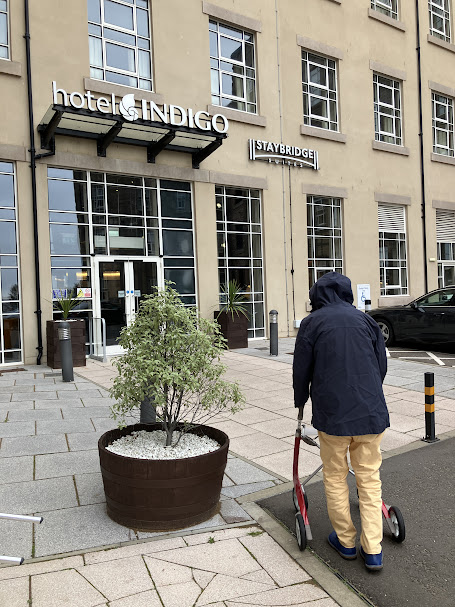
There was a little light rain when we arrived at Hotel Indigo.
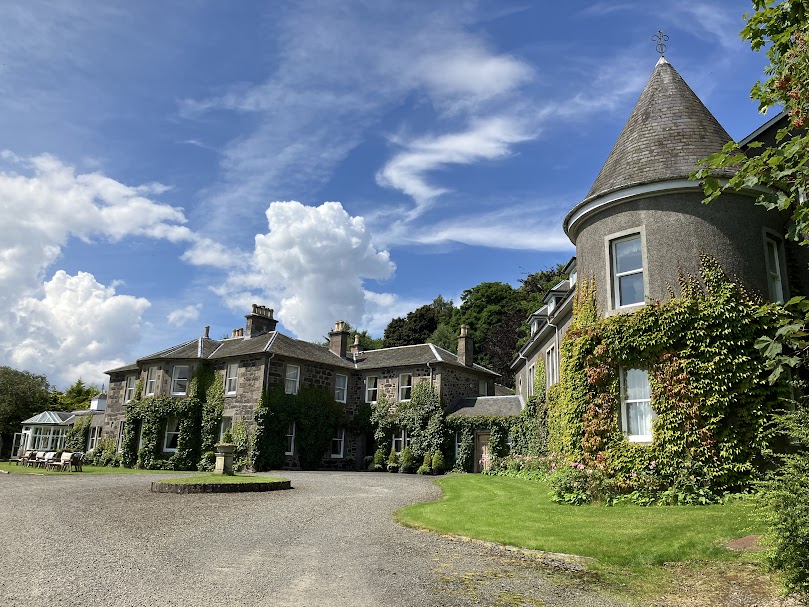
Arriving at Hotel Indigo, Dundee.
Inside, the lobby was comfortably laid out in a minimalist style, with artwork on the walls relating to the building’s past.
Soft seating in the lobby of Hotel Indigo, Dundee.
We walked through this area to the bar, which was empty, with no sign of any staff.
‘Eighteen22’, the bar at Hotel Indigo, Dundee.
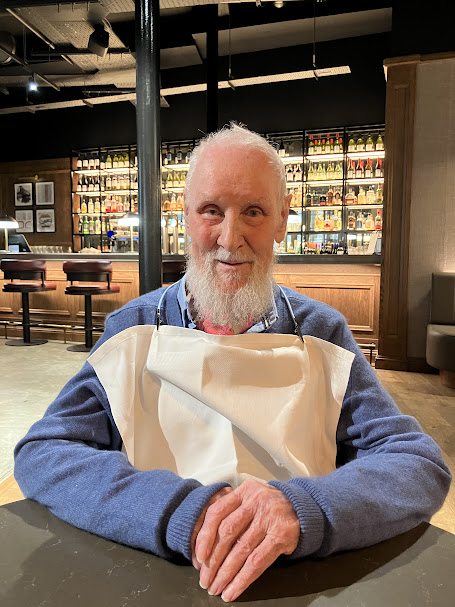
Having checked with the receptionist that lunches were indeed being served in the bar, we chose a seat, sat down and got settled for our meal. I removed my jacket, put on my bib, and waited for someone to appear.
Ready for luncheon at the Hotel Indigo, Dundee.
After a while, Lorna peered over the bar to see if there was anybody about, but all was silent. She went back to the lobby and explained to the receptionist that there were no staff in the bar. The receptionist left her desk and went on the hunt for the barman. She said he would be about somewhere, but after a while of searching she came back and told us he had vanished. We sat there a little longer, and eventually decided we should go elsewhere for our lunch as it was getting close to 14:00 by this time. The receptionist was very apologetic, so we left on a pleasant enough note.
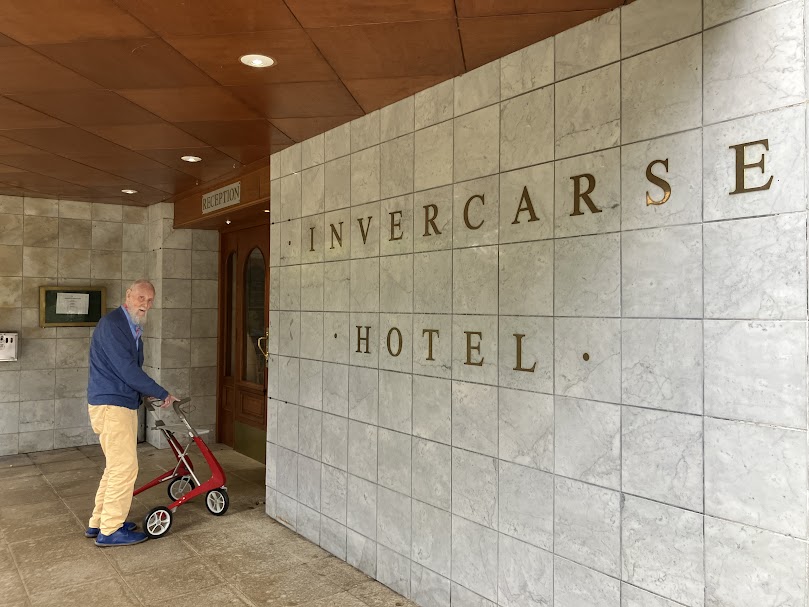
Lorna remembered another Dundee hotel she had once had a meal in when I was in hospital, and we decided to go there instead. She couldn’t remember the name of it but she knew it was near the Botanic Gardens, so we went off in search of it. We found it, got parked, and got ourselves out of the car. We had seen diners through the restaurant window as we drove into the parking area, so we felt pretty confident of obtaining a meal there.
Arriving at the Invercarse Hotel, Dundee.
Once inside the warm and welcoming lobby, Lorna spoke to the receptionist, who informed us that we were too late for lunch as they stopped serving at 13:45.
Back we went to the car, and wondered what to do next. The Scottish Antiques and Arts Centre was a 15 minute drive away, and we knew it served food all day. It happens to be one of our favourite lunch spots, so we were happy with the idea of going there.
As we were driving along the busy A90, Lorna accidentally turned off the road one junction too early and we found ourselves in the village of Inchture. That was no problem as we could simply drive through it, re-join the main road and come off at the correct junction. As we drove along the main street, Lorna remembered that there was a hotel in the village, and she was interested to investigate it. Moments later we came upon it, parked outside, and Lorna popped in to ask if they were still serving lunches. She reappeared from the hotel entrance with her thumbs up, and out I got.
Inchture Hotel, joyfully open for lunch.
Meals were served in a restaurant called The Priory, built onto the side of the original hotel building. There was a ramped entrance I could use with my rollator, and we were warmly welcomed by a helpful waitress who showed us to a table near the window. We settled ourselves in, very glad to have found a lunch spot at last.
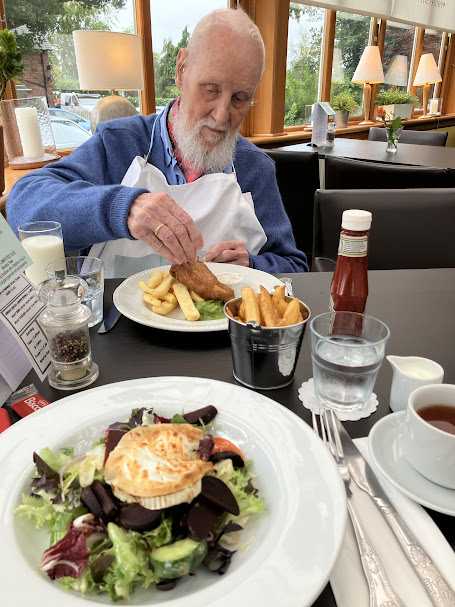
Happy and relieved to be settled in for lunch at The Priory in Inchture Hotel.
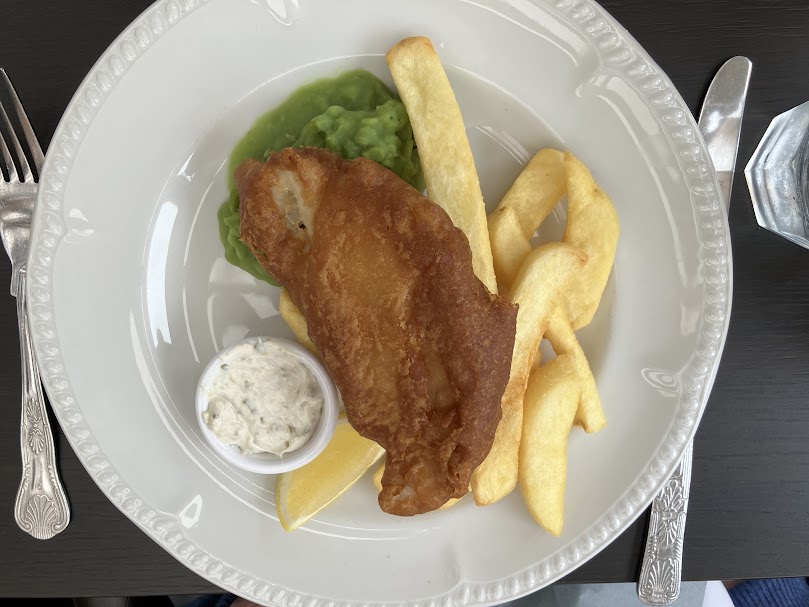
They had quite an extensive menu, and I opted for a small portion of battered haddock with chips and peas.
Small battered haddock at The Priory, Inchture Hotel.
Lorna chose the grilled goat’s cheese and roasted beetroot salad, which came with a little bucket of chips.
Grilled goat’s cheese and roasted beetroot salad at The Priory, Inchture Hotel.
We both very much enjoyed our meals in The Priory. Despite the late hour, there were quite a few other diners in the restaurant, and the atmosphere was warm and convivial.
Enjoying lunch at The Priory, Inchture Hotel.
The day had not worked out as planned, but we felt pleased with ourselves for having an adventure, particularly as it had ended in a tasty and satisfying lunch.
In July we revisited two old favourites, Dunkeld House Hotel and Gleneagles, both of which were excellent, as usual.
We also made our very first visit to a hotel that’s only 3 miles from our house. We’ve driven past it countless times, since it’s just off one of the main roads out of Blairgowrie. From the road, and even on their website, there’s no indication that non-residents are welcome, and we’d got the idea that it was rather an exclusive sort of place.
We had increasingly been thinking that one day we should bite the bullet and drive in to see what was what, and it took our fancy to do so on a warm, sunny Monday in mid-July when we were on our way to Pitlochry for lunch.
On the road below the hotel there’s a brown tourist road sign mentioning the name of the impressive building up the hill: Kinloch House Hotel. There are no other signs or boards indicating that it’s a hotel, which adds to the mystery of the place.
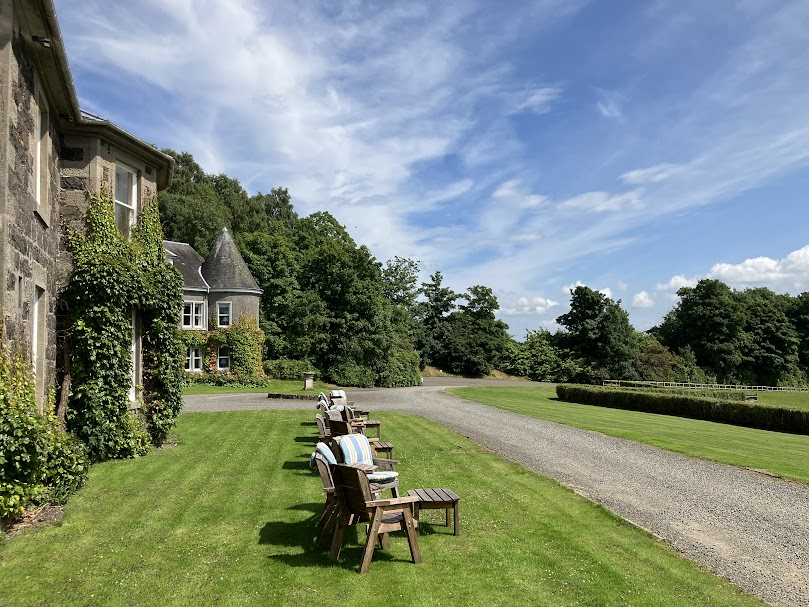
Kinloch House Hotel, near Blairgowrie.
Leaving me in the car, Lorna entered the building to find a very quiet, deserted interior. She had a look around, finding several soft seating areas and interesting wall decorations, and was eventually greeted by a courteous gentleman with a South African accent who asked if he could assist her. She asked him if the hotel served lunch, and he replied regretfully that they only did lunches on Sundays. Did they provide morning or afternoon teas, she enquired? Yes, he said, they could provide tea and coffee at any time, but again rather regretfully stated that the only edible accompaniments available were fruit loaf, lemon drizzle cake and shortbread. Lorna didn’t think that was anything to be sorry about, and she skipped back to the car to tell me the good news.
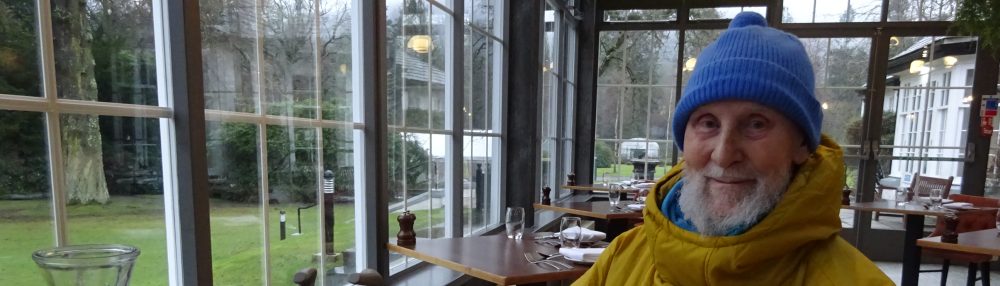
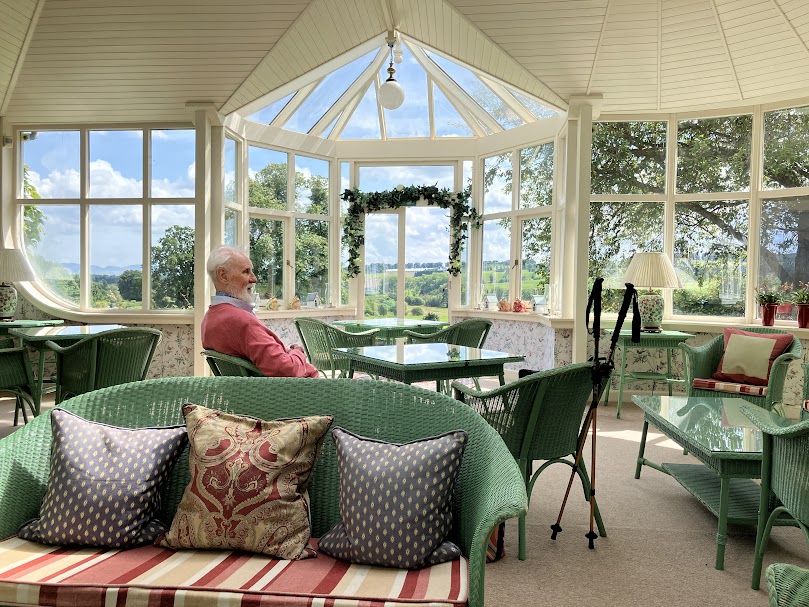
We continued on our way to Pitlochry, agreeing that one day we would settle ourselves in Kinloch House Hotel for hot drinks and cake. During lunch, at Pitlochry Dam Visitor Centre, we decided to stop at savoury courses and go back to Kinloch House Hotel that same day to sample their cakes by way of pudding. We were met by the same South African gentleman, who welcomed us warmly and invited us to have a good look round the hotel’s communal areas until we found the area we’d like to sit in. We did that, and opted for the conservatory, which was bright and airy, and very warm indeed.
Happily settled in the conservatory at Kinloch House Hotel.
We put in an order for tea and coffee, lemon drizzle cake and fruit loaf, and enjoyed the magnificently peaceful surroundings. While we were waiting, Lorna popped out of the open door and took pictures of the views. The main road lay just below the hotel, but we couldn’t hear any traffic as the hillside between the two seemed to absorb any noise.
The door out of the conservatory at Kinloch House Hotel.The front of Kinloch House Hotel from outside the conservatory.Beautiful views from Kinloch House Hotel.
Our South African server appeared with a large tray containing all we’d asked for, nicely presented with thick, white linen napkins. It was getting very hot sitting in the conservatory and we appreciated the large glasses of iced water he brought.
Enjoying a thick white napkin at Kinloch House Hotel.
It was extremely peaceful sitting there, and during the couple of hours or so we spent in the hotel, the South African chap was the only other person we saw. After we’d finished and paid for our repast, he invited us to sit in the conservatory or lounge for as long as we wanted. It was a tempting offer and we appreciated the kind hospitality, but sleep was calling me and my bed was only a few minutes’ drive away. Before we left, however, we enjoyed use of the facilities and had another little look around the hotel.
Exploring Kinloch House Hotel.One of the sitting rooms in Kinloch House Hotel.
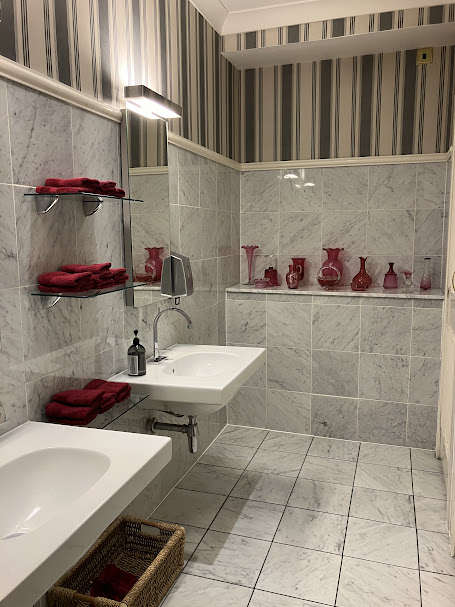
A beautiful bathroom at Kinloch House Hotel.
In August we were tempted back to Dunkeld House Hotel and Ballathie House Hotel for familiar pleasures, but we also had lunch at Fonab Castle Hotel and Spa in Pitlochry.
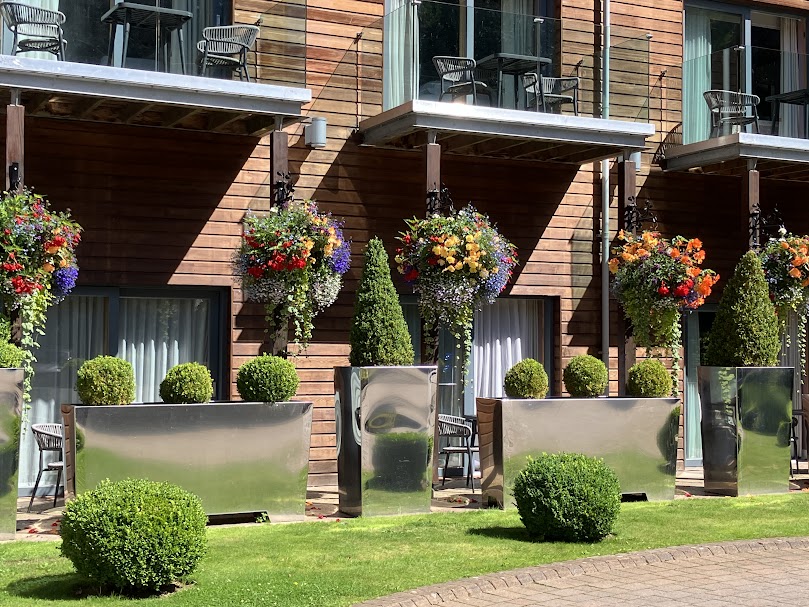
It being the height of summer, the hanging baskets outside the hotel were in full bloom and looking very colourful.
Burgeoning baskets at Fonab Castle Hotel, Pitlochry.
One of Fonab Castle’s greatest assets is its setting, with dining room views out over Loch Faskally.
Loch Faskally, viewed from the dining room at Fonab Castle Hotel.
We were presented with the full menu, but chose to order from the lighter afternoon options.
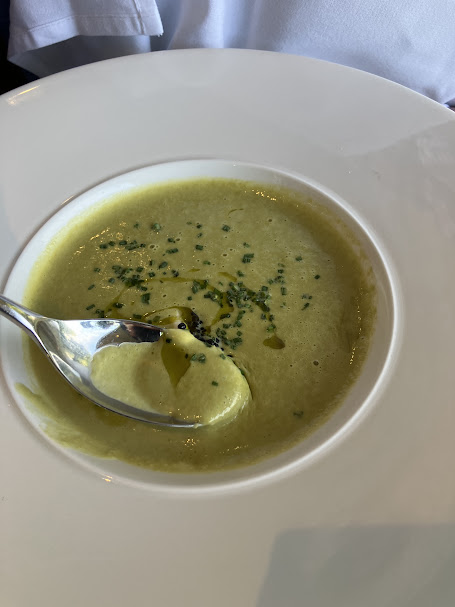
I chose the veloute of the day, the details of which neither Lorna nor I can now remember, but I’m sure it tasted good.
Veloute of the day at Fonab Castle Hotel.
Lorna had the garden salad, and was particularly pleased by the inclusion of olives. Since both of our choices were light options we ordered a side of chips to share.
Garden salad at Fonab.
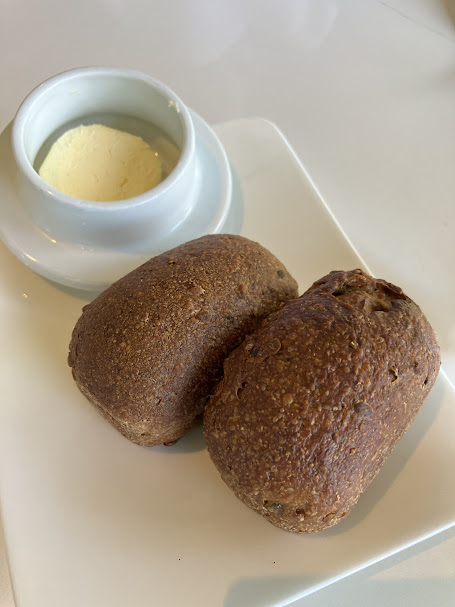
Small, warm and delicious wholemeal rolls were brought to the table, with a little pat of butter.
Delicious mini loaves at Fonab.
After our savouries, I chose a chocolate tart for pudding.
Chocolate tart at Fonab.
Lorna settled for a decaf latte, which was topped with a thick layer of foam and served in a handle-less insulated plastic cup.
Latte at Fonab.
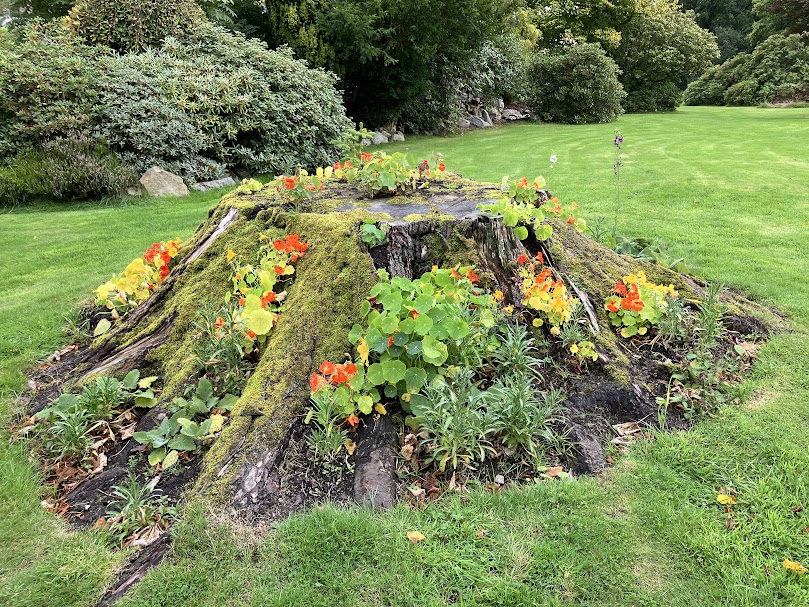
September saw us back at Ballathie House Hotel again, where we enjoyed the sight of an old tree stump planted with nasturtiums and other plants. It looked rather like a volcano.
An interestingly planted tree stump at Ballathie House Hotel.
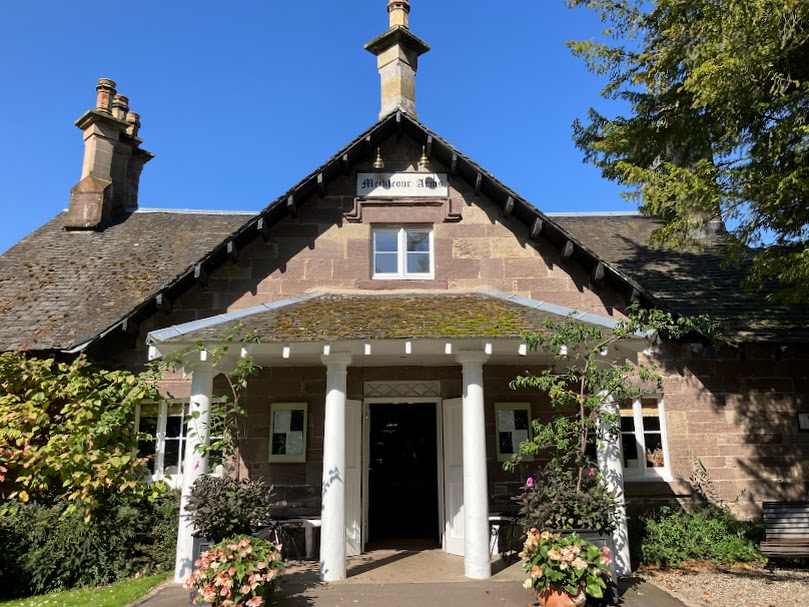
Later the same month we visited a hotel in the village of Meikleour, less than 5 miles from our house. We’d been there earlier in the year for hot drinks, and decided to call in for lunch on a beautiful sunny September day.
Meikleour Arms Hotel.
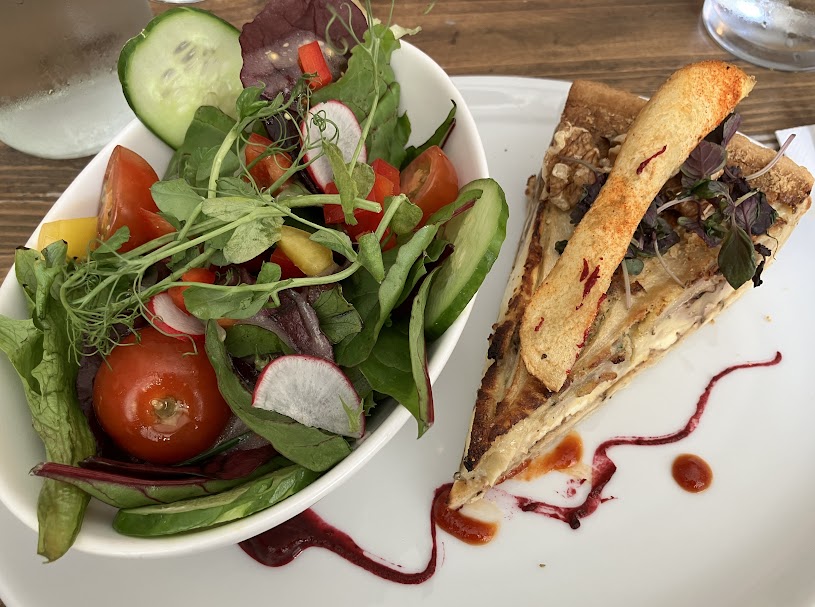
It was busy, as I believe it often is, being a popular spot with locals and tourists alike. Lorna and I both opted for the goat’s cheese, pear and walnut quiche, and were very glad we’d done so. It was delicious, and served with a tasty parsnip crisp and a bountiful bowl of salad.
Goat’s cheese, pear and walnut quiche at Meikleour Arms Hotel.
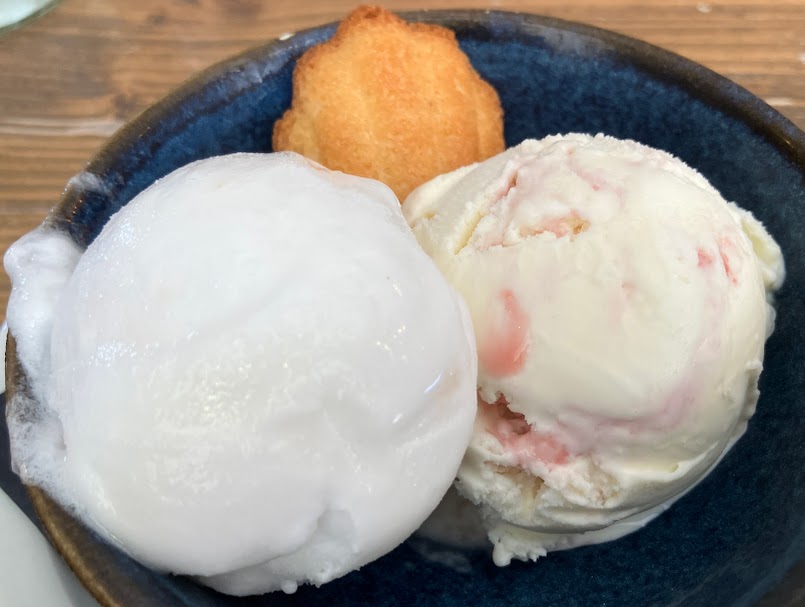
For pudding Lorna settled for a scoop of lemon sorbet and a scoop of raspberry ripple ice cream. She was delighted with the fluffy little madeleine that accompanied it.
Sorbet and ice cream with bonus madeleine.
I plumped for Victoria plum crumble, which came with a generous scoop of vanilla ice cream atop the well-filled crumble dish. It was surprisingly large and very tasty.
A well-filled dish of plum crumble with ice cream.
After partaking of coffee, I was glad my bed was in such close proximity to our luncheon spot.
The first day of October saw us visiting a hotel in the nearby village of Alyth that quite astounded us on our initial visit the year before. We had often seen signs for the Lands of Loyal Hotel while driving through Alyth, and for some reason always assumed it was a scruffy and neglected sort of place. The building isn’t visible from the main road, and I don’t know why we both had the impression we did, but for many years we’d avoided even going to investigate what might be there. After our first visit, which as I say astounded us, we felt inclined to go back and remind ourselves of its magnificence.
It was originally built as a private residence, but later took on the persona of a sort of country house hotel. It has a very unique atmosphere, and although we’ve been there a few times now, it continues to surprise us with its colouful and flamboyant decor.
Sitting comfortably by the fire in the lounge at Lands of Loyal Hotel.
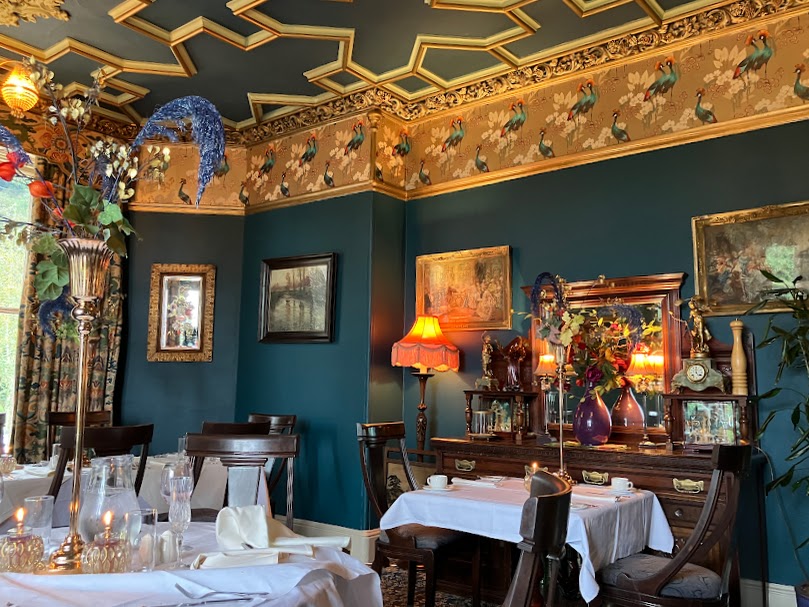
There are, I think, four separate dining rooms in the hotel, and we were put in one we hadn’t been to before. It was cosy and lavishly decorated.
One of the lavishly decorated dining rooms at Lands of Loyal Hotel.
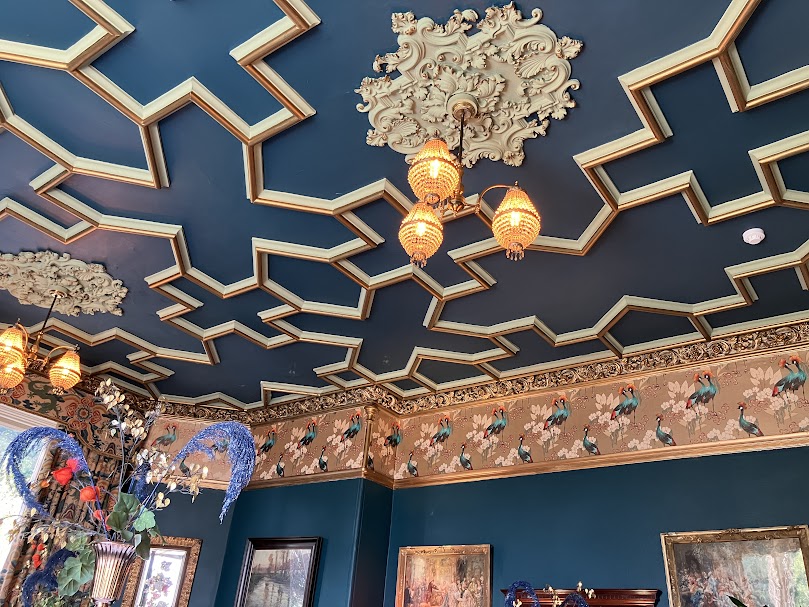
The ceiling in this room was particularly striking.
Striking ceiling in a dining room at Lands of Loyal Hotel.
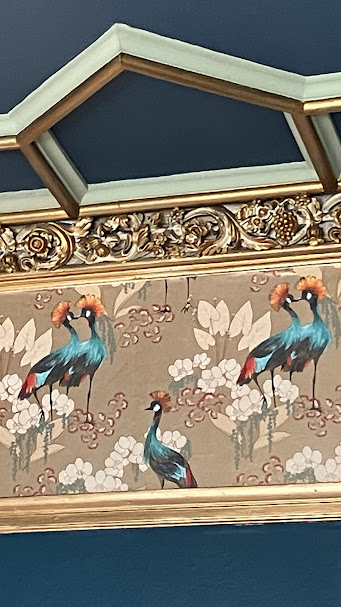
Exotic birds were displayed on a frieze just beneath the intricate gold-painted cornice.
Exotic birds at Lands of Loyal Hotel.
There was plenty to look at, and we enjoyed the peaceful ambience of the room as we waited for our food to arrive (we had perused the menus and made our order from the lounge area, where we were served drinks prior to the meal).
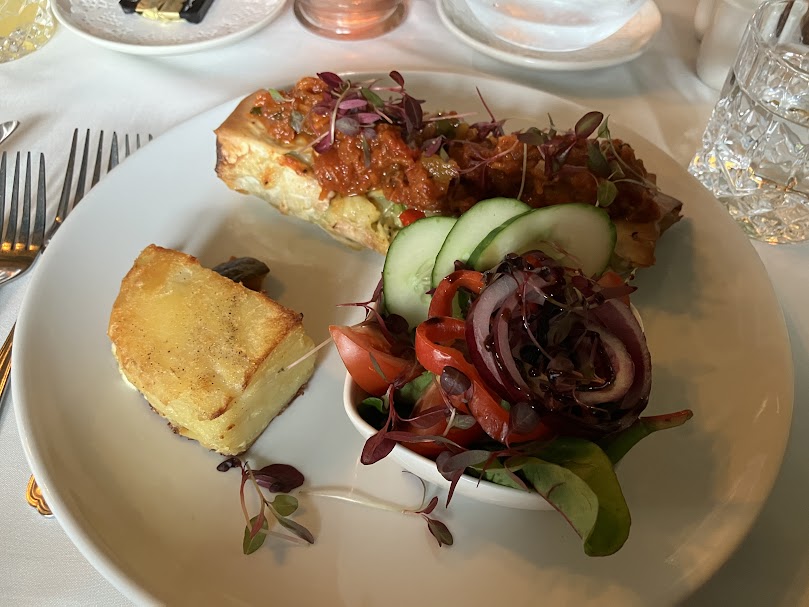
Neither Lorna nor I can now remember exactly what our dishes were, but they were well presented, and highly acceptable. I selected a starter and a dessert, while Lorna had a main course and no dessert. My starter consisted of a pastry tube stuffed with something that may have included mushrooms, served with a rich, creamy sauce.
Lorna’s main course was a vegetarian offering involving courgettes. She recalls the tomato sauce being particularly delicious.
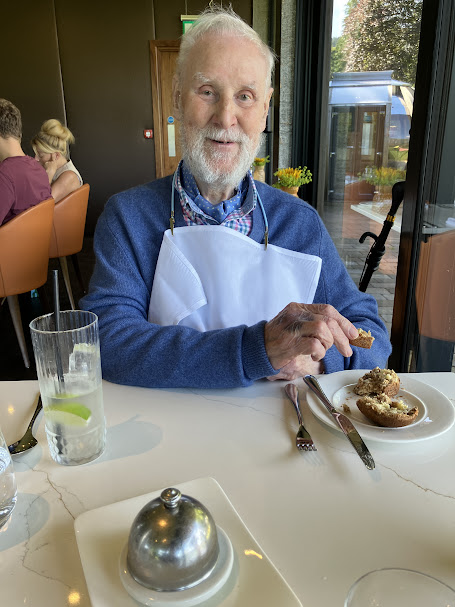
One of the things I particularly like in a restaurant is when they produce a bread roll and butter as part of proceedings. Lorna likes to see a carafe of water provided on the table. Lands of Loyal pleased both of us on these points, as well as ticking the boxes for thick linen tablecloths and napkins
My chosen pudding was a raspberry creme brulee. It was served in a large teacup, sitting on a piece of slate and accompanied by chantilly cream decorated with berries. It took me quite a while to get through it, but I persevered and polished it off.
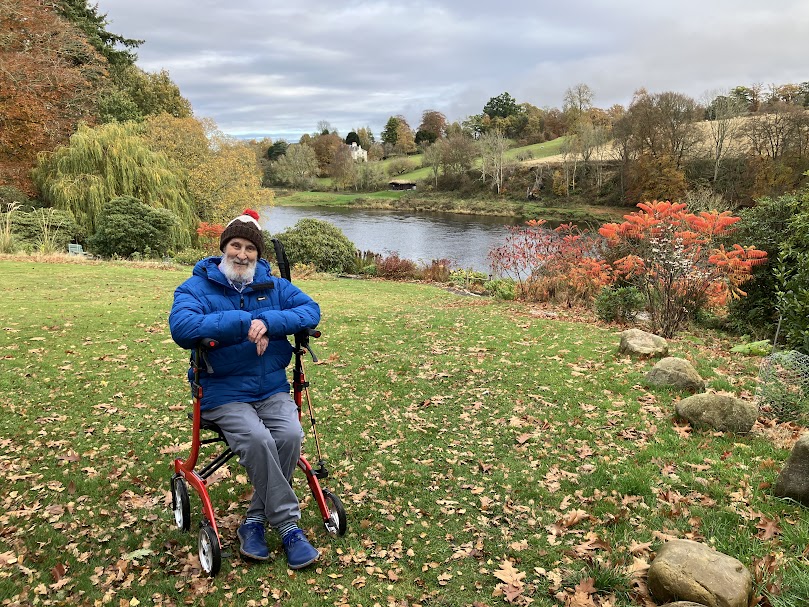
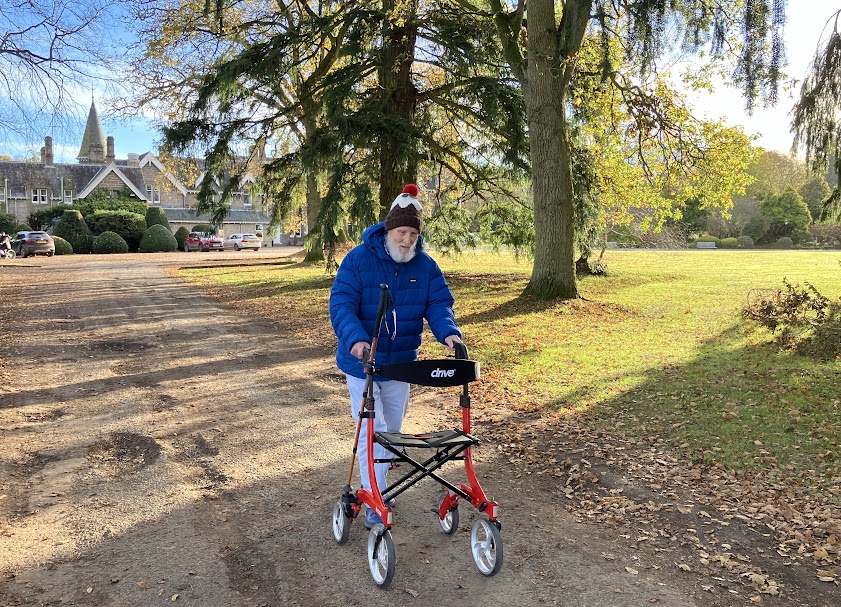
At the end of October we revisited Ballathie House Hotel, where we had a bit of exercise in their beautiful grounds, to work up an appetite for our lunch. My rollator, as well as being a very useful walking aid, provides a seat when I need a little rest.
Resting in front of the River Tay at Ballathie House Hotel, after a walk in the grounds.
Settled into the very quiet drawing room, we opted for sandwiches (egg mayonnaise for Lorna; tuna mayonnaise for me) and tea to drink. I usually prefer a cold drink with lunch, but it was a chilly day and the hot tea was very welcome.
Tea and sandwiches at Ballathie House Hotel.
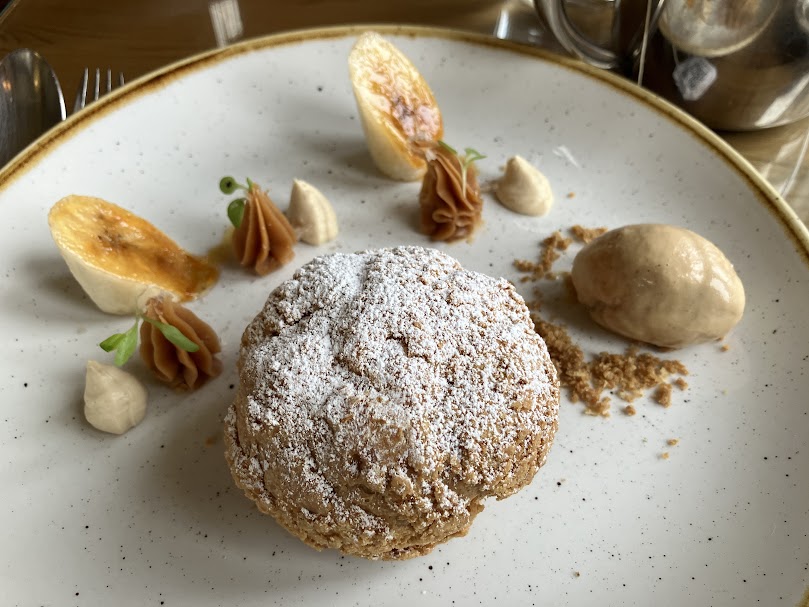
The dessert of the day was choux au craquelin with banana jam and salted caramel ice cream. Not being a big fan of bananas, I opted for a cream tea, but Lorna was quite excited to try the craquelin, and was delighted by the look of it.
Choux au craquelin with banana.
The cream tea came, as usual at Ballathie, with shortbread as well as a scone. It was up to the usual excellent standards.
Cream tea at Ballathie.
Delving into a cream tea at Ballathie.
In November, we revisited both Gleneagles and Ballathie.
One of my favourite dishes in The Dormy restaurant at Gleneagles has been their vegetarian haggis with neeps and tatties in a whisky cream sauce. They used to have it on their menu as a starter and a main course, but these days only advertise it as a main course. However, if you ask for a small portion they serve you the starter size, which is quite big enough a meal for me.
Haggis starter at The Dormy, Gleneagles.
Lorna had a dish she’s had a number of times, a curry consisting of paneer cheese and spinach. Sometimes it’s extremely spicy, other times very mild. This time it was rather over-salted, but I’m told the rice was excellent, as always.
Palak paneer at The Dormy, Gleneagles.
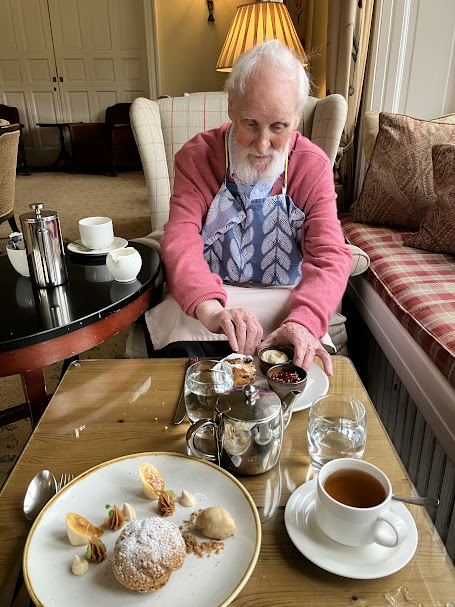
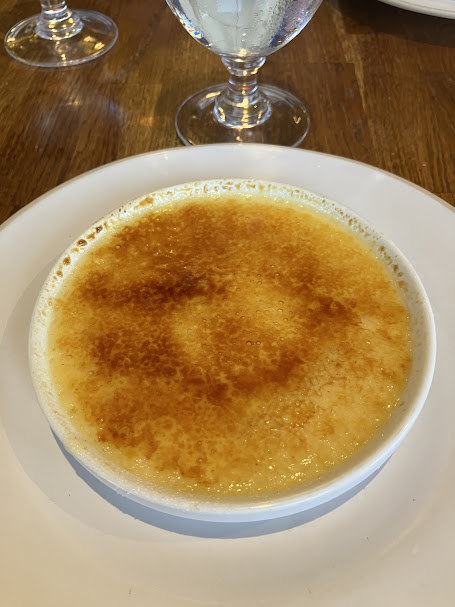
One of the Dormy’s best desserts is usually their creme brulee. Since it’s rather large and we both only had a little space left, we ordered one to share. It wasn’t up to the usual standards, and I wonder if there had been a change of chef. We managed to polish it off all right, mind you.
Creme brulee at The Dormy, Gleneagles.
On our visit to Ballathie later that month, again we started with a little exercise in the grounds…
Walking at Ballathie House Hotel.
…before settling ourselves into the drawing room, which I like to think of as my second home.
Settled into the drawing room at Ballathie.
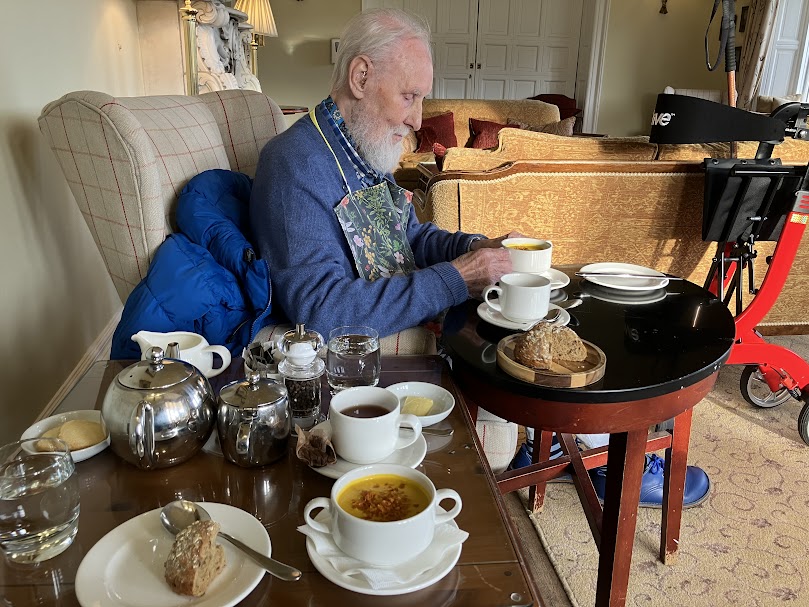
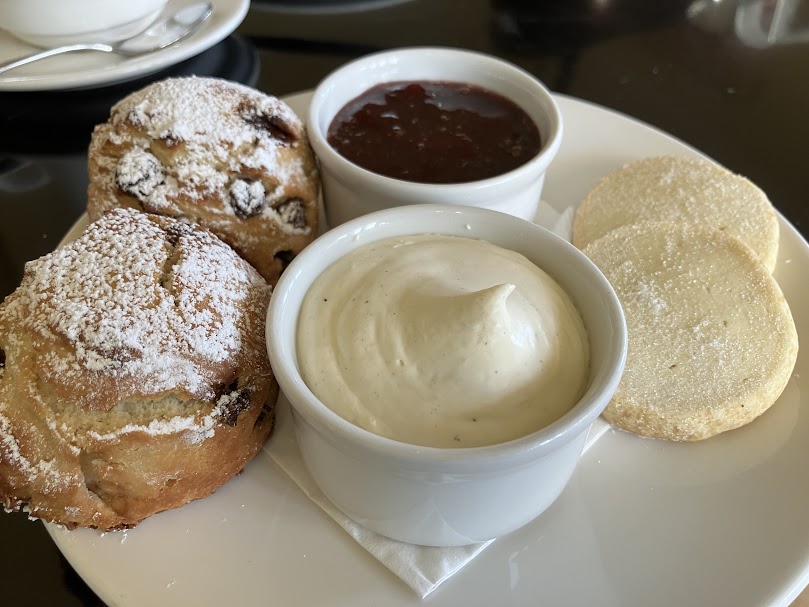
We both had carrot soup, followed by cream teas, all of which was exactly as expected and highly satisfactory.
Carrot soup at Ballathie, with their excellent homemade bread.Cream tea perfection at Ballathie.
We had several good meals out in December, but the only hotel we visited was the Atholl Palace Hotel in Pitlochry, where we met my other daughter, Flora, for lunch one day.
The hotel had been decked out for Christmas, and had a cosy, festive feel.
Huge Christmas tree at the Atholl Palace Hotel, Pitlochry.
Atholl Palace Hotel, Pitlochry.
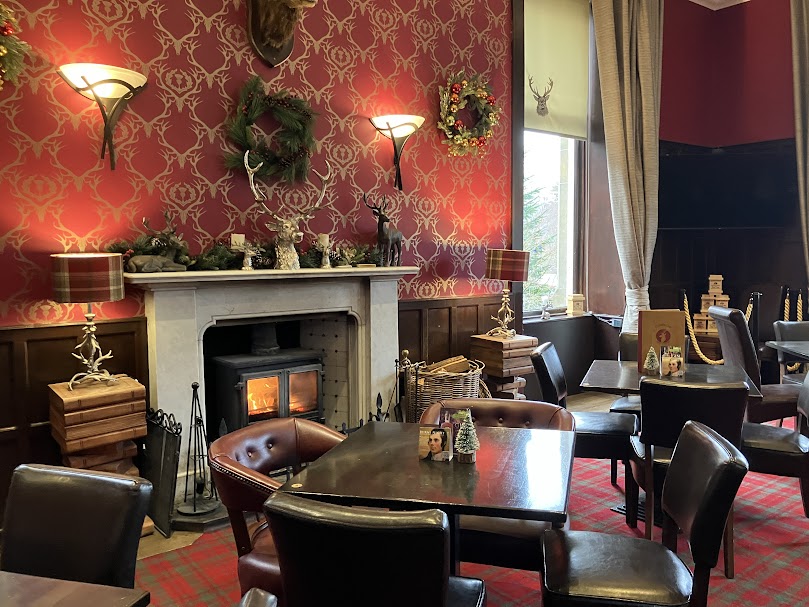
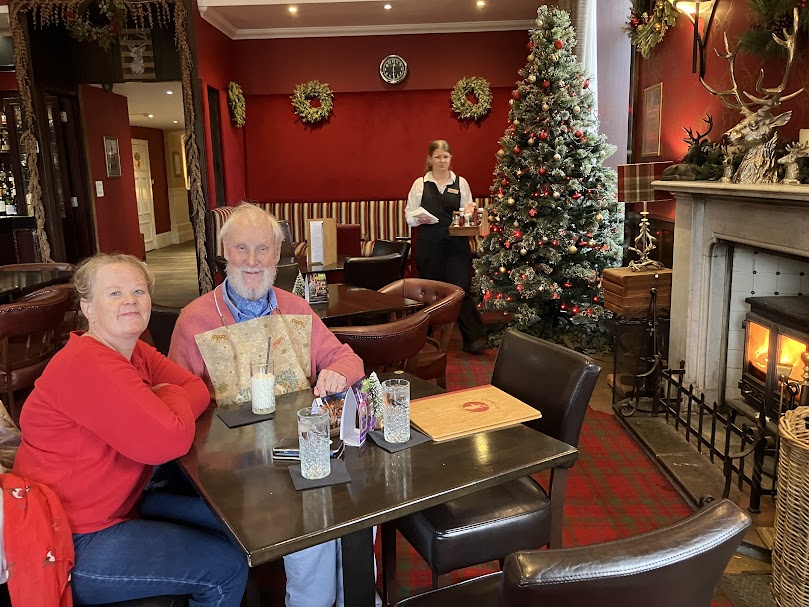
There are two dining options at the Atholl Palace, their main restaurant and the Stag Bar. We chose the bar, which was festively decorated and had a welcoming log fire.
Stag Bar at Atholl Palace Hotel, Pitlochry.
Lorna forgot to take photographs of the food we had, but I’m told we had soups and sandwiches. We enjoyed our time there, and the pleasure of an extra dining companion.
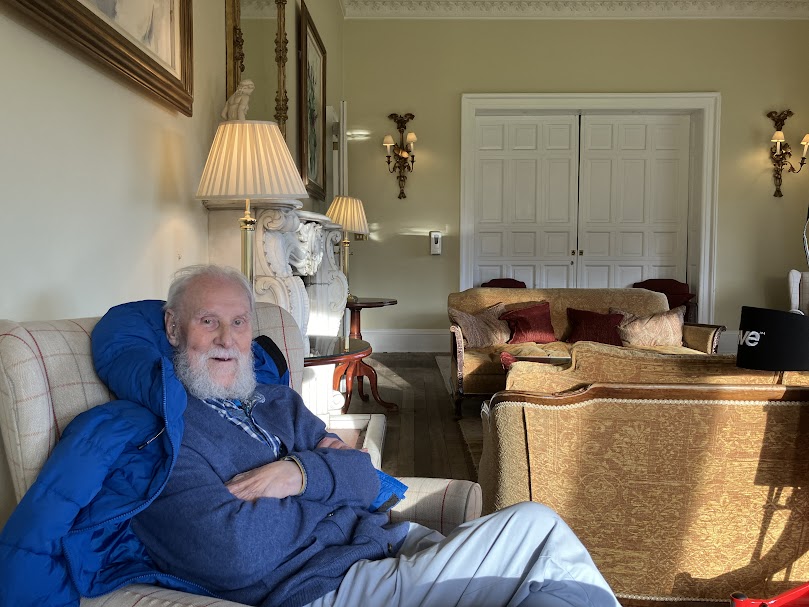
Flora and me in the Stag Bar, next to a warming fire.
It’s approaching the end of January 2025 as this is being written. The only hotel we’ve visited so far this year is Dunkeld House Hotel, but we’re planning to visit a new one to us at the end of this month, the Pine Trees in Pitlochry. We’ll be celebrating Lorna’s birthday, so I hope it will be a very pleasant and memorable occasion. If it turns out to be both, it might well appear on this blog in due course.
One of the most unexpected things that happened to me last year occurred on a sunny September day, when Lorna and I had a day out.
We headed north from our home in Blairgowrie, not sure where we would end up, but interested to see where the car might take us. We drove up the A93 towards Braemar in search of morning coffee and saw a sign advertising Dalmunzie Castle Hotel. Rather unusually, in addition to offering lunches and dinners to non-residents, the sign specifically mentioned morning coffees. We pulled off the road and drove slowly up a long, private driveway to the castle.
The building sat in a quiet and sheltered glen, and the sun was shining magnificently from a blue sky. We parked the car and entered the castle through a heavy wooden door. Inside, we found a comfortable lounge area, settled ourselves in and ordered coffee and tea, which came with delicious home-made shortbread biscuits.
Bennet lounging about in Dalmunzie Castle Hotel.
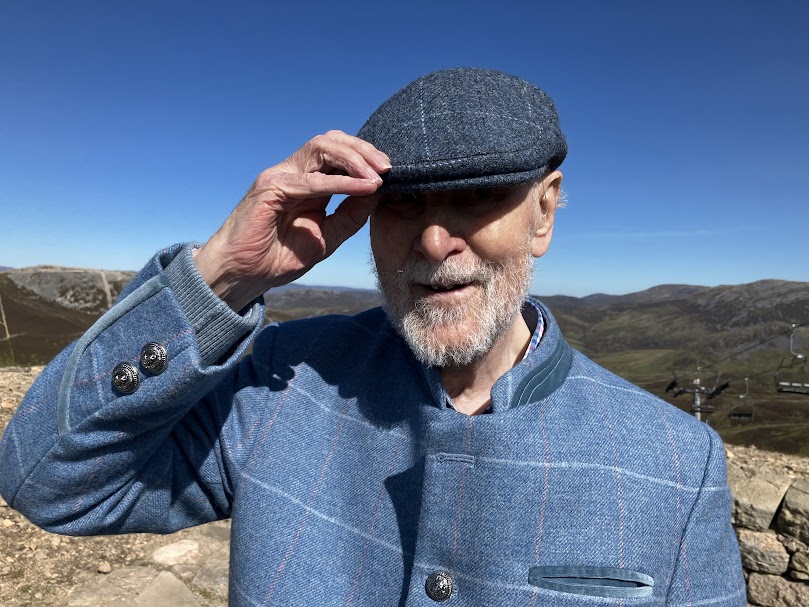
Happily refreshed, we continued our journey north. As we climbed up into the mountains, we passed the Glenshee ski centre, and noticed that although there was no snow at that time of year, the chairlift was operating. Lorna suggested it would be fun to get on the chairlift and go up the mountain, but I quickly reminded her that at my great age of 94, such an escapade held no attraction for me. I said I would wait if she wanted to go up on her own, but she wasn’t interested in that and we drove on. After a minute or two it occurred to me that if I had headgear that wouldn’t blow off, I could be persuaded to go up on the chairlift, and I said so to Lorna. The floppy-brimmed sunhats we had in the car didn’t seem suitable, but we had the idea of looking for a new hat in Braemar.
When we reached Braemar we went into a gift shop that also happened to have an impressive array of hats. I was drawn to several hats with brims of various sizes, but none of them seemed quite right. After much trying on, we found a hat of a different sort that looked as if it might be just the job. It went well with the outfit I had on and seemed to be the perfect purchase, so we bought it.
Bennet in his new bunnet in Braemar.
Thus suitably attired, I felt ready to head back down to Glenshee and hop on the chairlift. It was a first for both of us to go on a chairlift, and it wasn’t until she was several metres above the ground that Lorna remembered she had a fear of heights. She gripped the handrail tightly and I did my best to assure her that all was well. As we rose up the mountainside, the wind increased considerably. I held on to my hat to prevent it from flying off. Fortunately, it was a nice tight fit.
At the top, holding on to new hat.
After being helped off the moving chairs by an assistant, we staggered to a viewpoint where I was glad to sit down and take in the magnificent views.
At the viewpoint, admiring the surrounding scenery.
We stayed up there until our hands became numb in the cold wind. We were glad to get back on the chairlift and enjoy the shelter of the mountainside as we came down. The views were wonderful.
Coming down: a pleasant experience in the shelter of the mountainside.
Having overcome her initial terrors, Lorna declared she’d happily do it all again, but we agreed to keep that for another occasion. We spent the rest of the day feeling surprised and delighted by our unexpected mountain adventure, and it has provided happy memories for us both ever since.
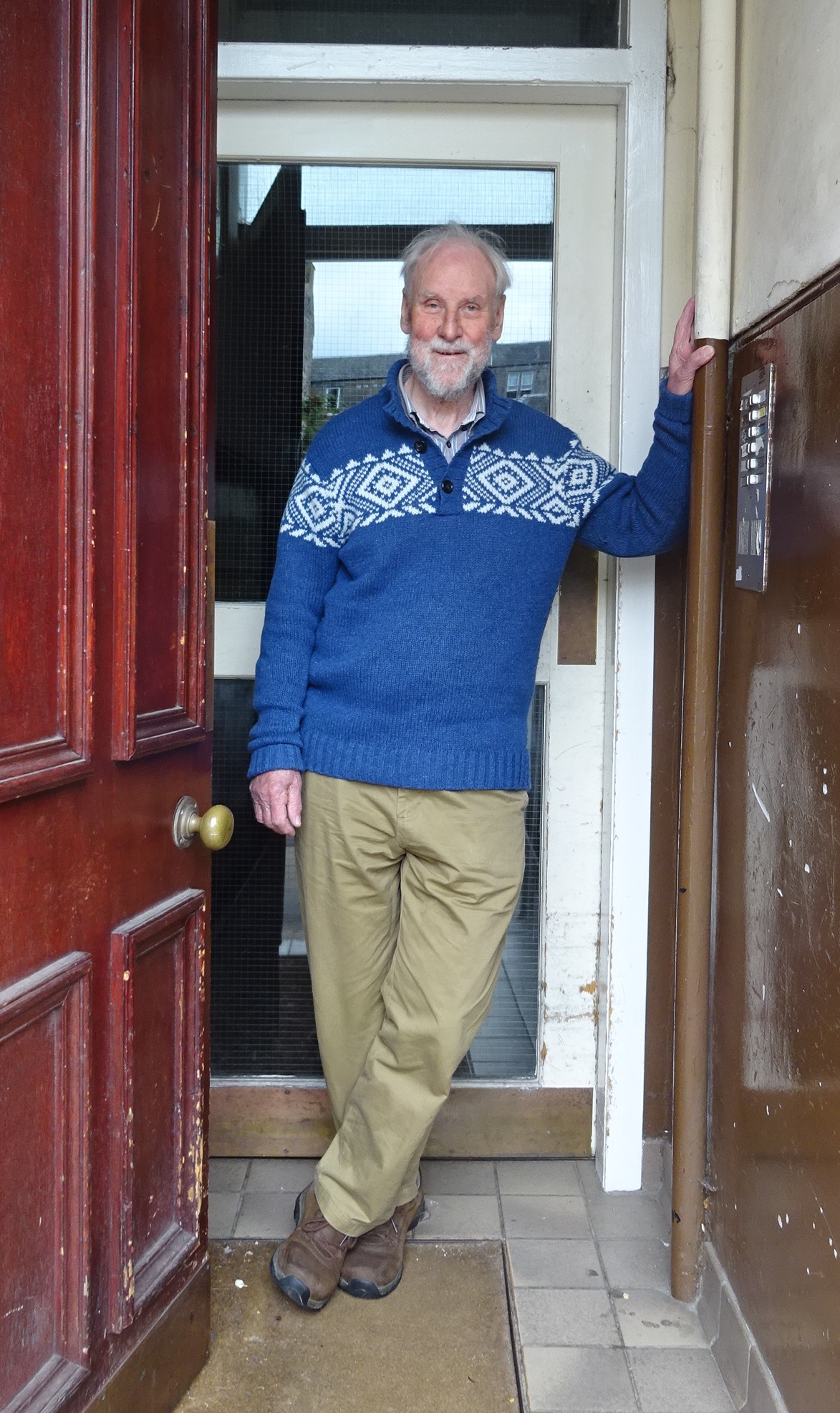
The following photograph, taken in September 2015, shows 15 Cathcart Place, a residential tenement in Edinburgh. It has eleven small flats (apartments) and I was born in flat 8 (on the floor below the top floor). That was my home from 1929 to 1934. The three windows on the left side of this shot belong to flat 8, including the one with a white blind. (I’m standing in the street level entrance door that leads to the internal stair.)
The flat has two rooms looking out over the street. The two narrow windows on the left of the photograph are in what we called the parlour, a room used mainly when we had visitors. The wider window with a white blind is in what was Granny’s bedroom. The other windows of the flat are on the far side of the building.
The next photograph shows the internal stair. The property now has mains electricity but when I lived in it there was none. At night, especially in winter, the stair was dark and a battery-operated torch was often in use. A grassy communal area at the back of the building was formerly used for hanging out the washing but there was none there when I visited.
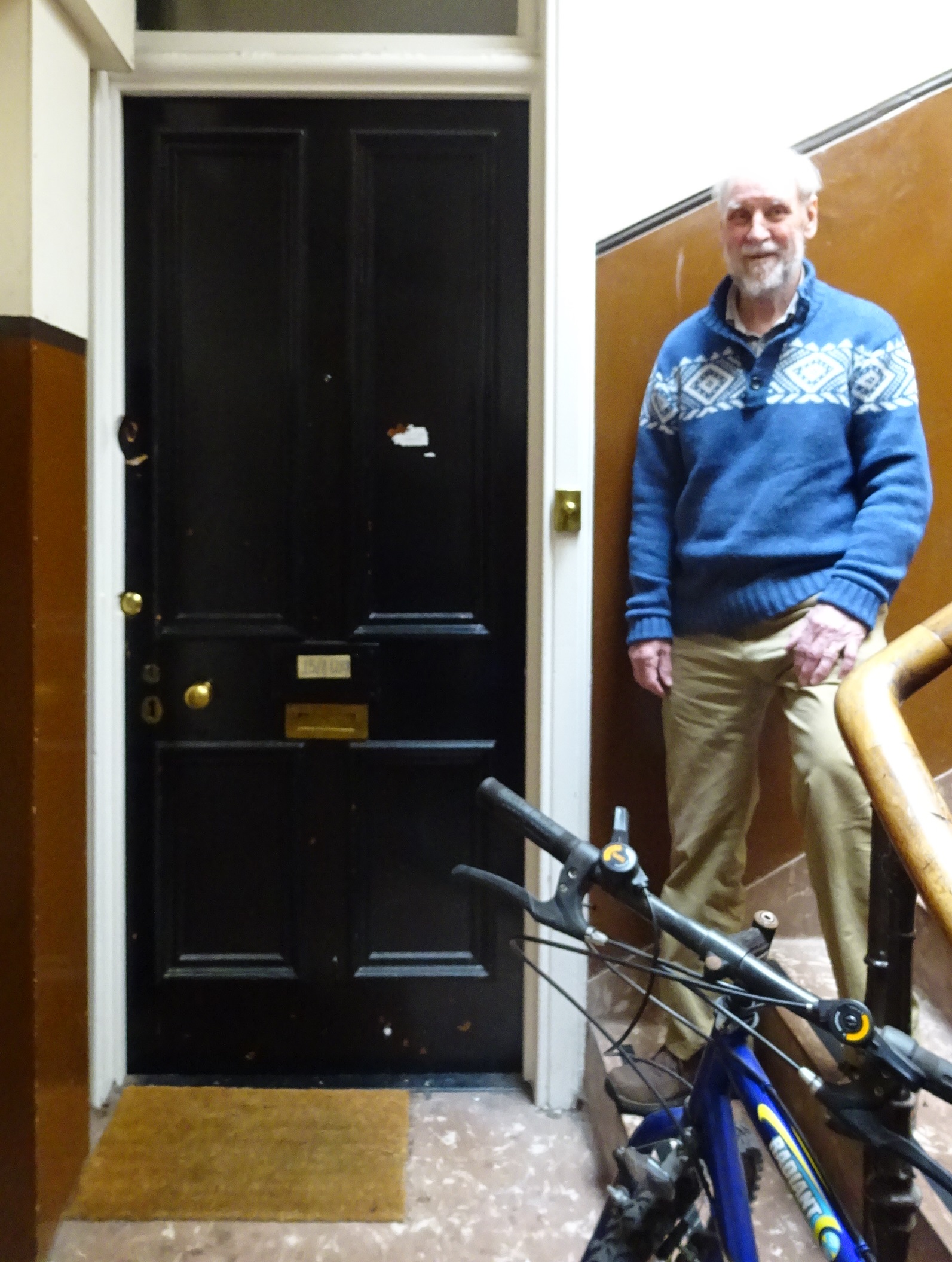
There are twenty or more steps between floors. The next photograph shows me two flights up, outside the door of flat 8.
The busiest room in the house was the kitchen. It has a wide window that faces northeast, looking out over the city of Edinburgh towards the Firth of Forth. When I lived in this flat the kitchen had a cast iron range with at least one built-in oven heated by a central coal fire. An iron kettle could be hung over the fire to boil water. Heavy iron pans could be balanced above the fire.
The kitchen had a large central table where meals were prepared and eaten. In the window recess there was a large kitchen sink with one cold water tap. When hot water was needed it was transferred in a kettle from the range. In a corner of the room away from the window there was a bed recess, an area large enough to take a double bed, and it may have had a curtain that could be drawn across to make the area into a little bedroom. That was where my parents slept.
Coal fires were the only form of heating in the house when I lived there. The fire in the range was kept burning most of the time, and there were fireplaces in Granny’s bedroom and in the parlour. The house had no mains electricity. It did have mains gas but that was used only for gas lamps, suspended from the ceiling in each of the three main rooms. A fanlight over the flat door did allow some daylight into the hall.
There was no bathroom in the flat – only a small toilet opening off the hall. This small room had no window, but it did have an electric battery torch fixed to the wall. When I was small I was probably bathed in the kitchen sink or in a large zinc tub placed near the range in the kitchen. When I was older I remember my father taking me on a short walk to the nearby public baths where he paid for a bathroom that had a very large bath with lots of hot water available. I think we had the choice of taking our own towels or of hiring towels there.
I left 15 Cathcart Place after this brief visit to my childhood home still struggling to remember how life had been for me all those years ago.
In the previous post I quoted from an account given by my father, Robert McInnes, of his departure from civilian life in Edinburgh in 1914 when he was called up for military service in France. In 1918 (or it may have been in 1919) he returned to Edinburgh to live with his parents and to resume his work in the wholesale fruit and vegetable market.
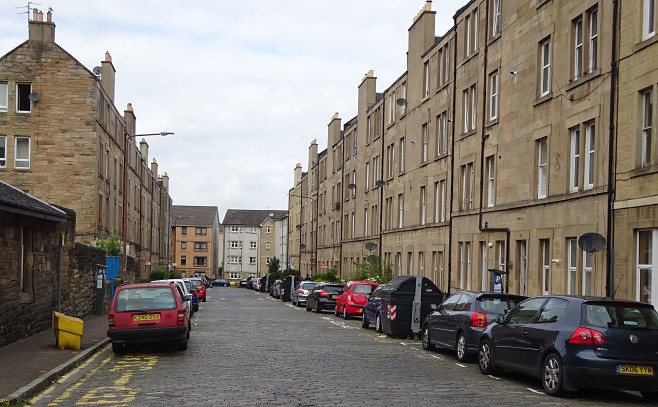
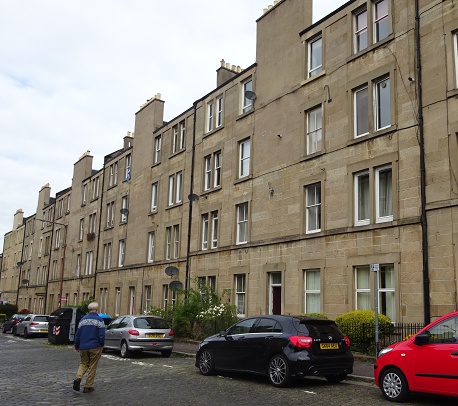
On a recent visit to Edinburgh I was able to go to Cathcart Place, the street where both my father and I were born (in different houses). The road is paved with ‘causies’ (causeway stones) and it looks much the same as it did when I was a child, except that now there are painted lines – white lines showing where cars may be parked, and yellow ones where parking is forbidden or at least discouraged. There were very few cars in this part of Edinburgh in the 1930s. I and the other local children were able to play in the street, unaffected by traffic.
On either side there are ‘tenements’, the local name for apartment blocks. These ones were built well over a hundred years ago. About half way down on the left is number 20 and one of the flats in that tenement is where my father lived with his parents and his three siblings till after the war had ended.
My father’s workplace in Market Street was about a mile and a half from his home and he made that journey routinely four times a day. There was a frequent tram service down Dalry Road to Haymarket and then along Princes Street past Edinburgh Castle to Waverley Station, where the Fruit Market was, but he usually made the journey on foot, often walking through Princes Street Gardens rather than along the street itself.
Deliveries of fruit and vegetables arrived overnight in closed wagons at a railway siding that ran along Market Street below street level. The wholesale fruit and vegetable companies owned properties that lined that siding and their staff arrived early in the morning, before 07:00, I think, to unload the wagons into the warehouses. Retailers came during the day to purchase what they needed for their shops in the city and in neighbouring towns and villages.
Wood Ormerod, the company for which my father worked, supplied a cooked breakfast for their staff at around 09:00 and then allowed them a long meal break in the middle of the day. My father used to walk home for that meal (called dinner rather than lunch) and then back to work again for three or more hours before returning home for the evening meal (called tea, although it usually included a substantial cooked dish). I realize that he led a disciplined life, with good meals and healthy exercise, often walking around six miles a day.
His mother died in 1924, aged 66, and at about that time the family moved from their flat in Cathcart Place to a top floor flat at 52 Dalry Road, a short walk away.
Here is a photograph of that flat. It has two windows looking out to Dalry Road below, three windows looking west, and another four windows (not visible in this shot) looking north.
Also in Dalry Road, not far from number 52, there was a shop that sold umbrellas, leather handbags, and a variety of items that were described as fancy goods, which is where my mother comes into the story.
Marjory Duff Watt was the youngest of the four children of Andrew Watt and Anne Morrison. She was born on 14 February 1896 and lived at 2 St David’s Terrace, near Morrison Street in Edinburgh. Madge (as she was usually called) went to Torphichen Street School and left in 1910 when she reached the age of 14. Her mother had been looking out for a career opportunity for her, although that sounds rather too grand: basically she wanted to help her to earn a living. One day in 1910 my grandmother walked down Morrison Street to Haymarket and then up Dalry Road. There she noticed an advertisement in the umbrella shop window inviting job applications for work as a sales assistant. I don’t know if Madge had expressed any interest in such work but her mother took her to the shop and she got the job, which she continued to do for the next sixteen years. The shop was about half a mile from her home.
The owner of the shop, Tom Chambers, happened to be a member of the Glanton Brethren Assembly in George Street which was attended by the McInnes family. Young Madge was invited to join a Bible Class that was led by a member of the Chambers family. She did so and eventually decided to leave the Church of Scotland to which her family belonged and join the Brethren. The Church of Scotland minister tried to persuade her that she was just the type of sincere Christian that he needed in his congregation but she remained convinced that she ought to leave. She remained a member of the Glanton Brethren for the rest of her life.
Madge’s father died in 1919 and when her three older siblings married and left home she became her mother’s main support and I expect that eventually her earnings provided most of the family income. My grandmother may well have wondered what would happen to her if her daughter got married.
I do not know when Madge Watt became friendly with Robert McInnes but I do know that they would often meet each other at the Sunday services and other meetings of the Brethren. He would sometimes go into the umbrella shop as he passed by on his way to or from his dinner. When I was a child my mother told me that on one occasion he demonstrated the filling effect of his meal. Like most men at that time he wore a three piece suit. The sleeveless waistcoat had a small belt at the back which could be adjusted. One day Robert loosened his waistcoat when he left work for the dinner break and called in at the umbrella shop to say hello. He pointed out that his waistcoat was very loose and remarked that he was feeling hun gry. After dinner he called in again and demonstrated that his dinner had made a noticeable difference: the waistcoat was now very tight! I wasn’t sure that I believed my mother when she said that she was fooled by this demonstration.
The friendship flourished and on 2 June 1926, when he was 33, Robert McInnes married Madge Watt. I think that his parents’ flats in Cathcart Place and Dalry Road had been rented properties. Robert was not highly paid, but he had been saving up to buy a home for himself, and before the wedding he had bought a flat in 15 Cathcart Place, across the street from his boyhood home. That tenement is on the right of the Cathcart Place photograph above (beyond the red car) and the photograph below shows me walking towards the street level entrance door.
In the next post I hope to write more about the house where I was born.
It was a frosty morning at the end of January 2012. An old man sat comfortably in his house, with a mug of tea in his hand. As he looked out over the white roofs of the houses nearby, he thought about how many mornings he had experienced in his life so far. A rough calculation showed that the number had already passed thirty thousand. He was relieved that he did not have detailed memories of all these mornings, but he knew that they had all happened, and that the events of the thirty thousand days that followed them had been woven into the tapestry of his life.
What was his earliest memory? He had seen photographs of himself as a toddler, including one taken in a photographer’s studio where he was standing with his hands on a small stool, possibly because he would have fallen over without its support. He was warmly dressed in a fluffy woollen coat and hat, corduroy leggings, and thick mitts. He had no memory of the photograph being taken, but he had no doubt that he had been in that studio and that this picture was evidence of a day in his life that had probably been as frosty as today was.
In 1930 I was the toddler in that photograph, wondering what the photographer was doing. In 2012 I was the old man with the mug of tea, thinking about my past life, more than eighty years long so far.
As I rack my brain to recall early memories I remember something that happened when I was about three years old. My uncle James, my father’s brother, had been showing me how to produce the domino effect, setting up a row of wooden bricks on their narrow edges so that when the first one was tapped to make it fall over it knocked over the rest of the row. I have a definite memory of that event, and can almost hear again the clatter of the bricks as they tumbled down in a long line. But it’s only a partial memory and I cannot visualise the room where it happened. My uncle died on 9 May 1932, aged 35, ten days after my third birthday.
In writing this blog I want to explore some of the ways in which my life has developed. In particular, I should like to review those times when I made choices that had significant consequences for me and for other people. I believe that I’m accountable for my actions, in this life to my family and to society at large, and beyond this life to my creator.
My grandmother, my mother’s mother, lived with my parents from their marriage in 1926 for the remaining seventeen years of her life. She died in 1943, when I was fourteen. Among other memories that I have are those of her sitting quietly in her room reading from a large-print Bible. Was she swotting for her finals?




























 Bennet McInnes