In the previous post I quoted from an account given by my father, Robert McInnes, of his departure from civilian life in Edinburgh in 1914 when he was called up for military service in France. In 1918 (or it may have been in 1919) he returned to Edinburgh to live with his parents and to resume his work in the wholesale fruit and vegetable market.
On a recent visit to Edinburgh I was able to go to Cathcart Place, the street where both my father and I were born (in different houses). The road is paved with ‘causies’ (causeway stones) and it looks much the same as it did when I was a child, except that now there are painted lines – white lines showing where cars may be parked, and yellow ones where parking is forbidden or at least discouraged. There were very few cars in this part of Edinburgh in the 1930s. I and the other local children were able to play in the street, unaffected by traffic.
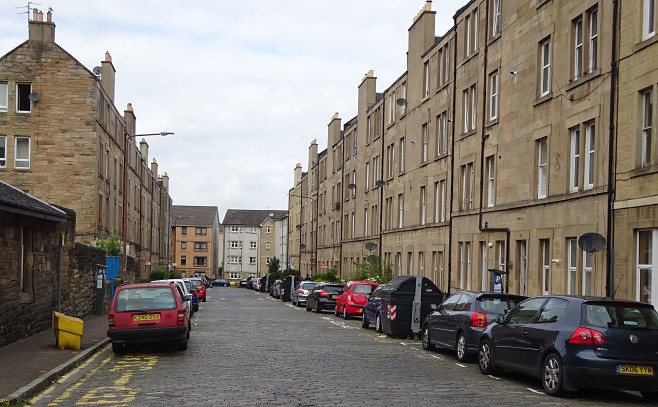
On either side there are ‘tenements’, the local name for apartment blocks. These ones were built well over a hundred years ago. About half way down on the left is number 20 and one of the flats in that tenement is where my father lived with his parents and his three siblings till after the war had ended.
My father’s workplace in Market Street was about a mile and a half from his home and he made that journey routinely four times a day. There was a frequent tram service down Dalry Road to Haymarket and then along Princes Street past Edinburgh Castle to Waverley Station, where the Fruit Market was, but he usually made the journey on foot, often walking through Princes Street Gardens rather than along the street itself.
Deliveries of fruit and vegetables arrived overnight in closed wagons at a railway siding that ran along Market Street below street level. The wholesale fruit and vegetable companies owned properties that lined that siding and their staff arrived early in the morning, before 07:00, I think, to unload the wagons into the warehouses. Retailers came during the day to purchase what they needed for their shops in the city and in neighbouring towns and villages.
Wood Ormerod, the company for which my father worked, supplied a cooked breakfast for their staff at around 09:00 and then allowed them a long meal break in the middle of the day. My father used to walk home for that meal (called dinner rather than lunch) and then back to work again for three or more hours before returning home for the evening meal (called tea, although it usually included a substantial cooked dish). I realize that he led a disciplined life, with good meals and healthy exercise, often walking around six miles a day.
His mother died in 1924, aged 66, and at about that time the family moved from their flat in Cathcart Place to a top floor flat at 52 Dalry Road, a short walk away.

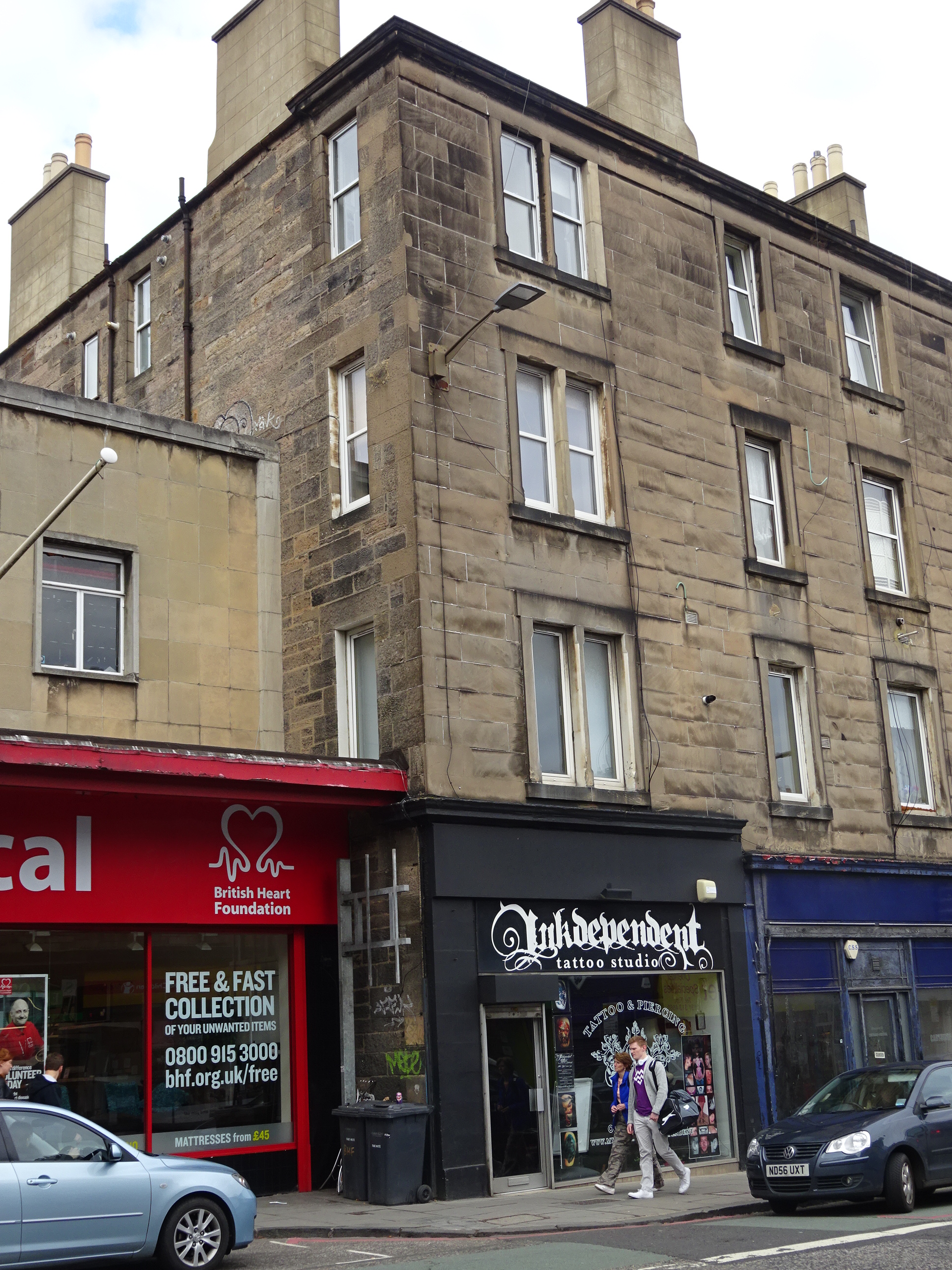
Here is a photograph of that flat. It has two windows looking out to Dalry Road below, three windows looking west, and another four windows (not visible in this shot) looking north.
Also in Dalry Road, not far from number 52, there was a shop that sold umbrellas, leather handbags, and a variety of items that were described as fancy goods, which is where my mother comes into the story.
Marjory Duff Watt was the youngest of the four children of Andrew Watt and Anne Morrison. She was born on 14 February 1896 and lived at 2 St David’s Terrace, near Morrison Street in Edinburgh. Madge (as she was usually called) went to Torphichen Street School and left in 1910 when she reached the age of 14. Her mother had been looking out for a career opportunity for her, although that sounds rather too grand: basically she wanted to help her to earn a living. One day in 1910 my grandmother walked down Morrison Street to Haymarket and then up Dalry Road. There she noticed an advertisement in the umbrella shop window inviting job applications for work as a sales assistant. I don’t know if Madge had expressed any interest in such work but her mother took her to the shop and she got the job, which she continued to do for the next sixteen years. The shop was about half a mile from her home.
The owner of the shop, Tom Chambers, happened to be a member of the Glanton Brethren Assembly in George Street which was attended by the McInnes family. Young Madge was invited to join a Bible Class that was led by a member of the Chambers family. She did so and eventually decided to leave the Church of Scotland to which her family belonged and join the Brethren. The Church of Scotland minister tried to persuade her that she was just the type of sincere Christian that he needed in his congregation but she remained convinced that she ought to leave. She remained a member of the Glanton Brethren for the rest of her life.
Madge’s father died in 1919 and when her three older siblings married and left home she became her mother’s main support and I expect that eventually her earnings provided most of the family income. My grandmother may well have wondered what would happen to her if her daughter got married.
I do not know when Madge Watt became friendly with Robert McInnes but I do know that they would often meet each other at the Sunday services and other meetings of the Brethren. He would sometimes go into the umbrella shop as he passed by on his way to or from his dinner. When I was a child my mother told me that on one occasion he demonstrated the filling effect of his meal. Like most men at that time he wore a three piece suit. The sleeveless waistcoat had a small belt at the back which could be adjusted. One day Robert loosened his waistcoat when he left work for the dinner break and called in at the umbrella shop to say hello. He pointed out that his waistcoat was very loose and remarked that he was feeling hun gry. After dinner he called in again and demonstrated that his dinner had made a noticeable difference: the waistcoat was now very tight! I wasn’t sure that I believed my mother when she said that she was fooled by this demonstration.
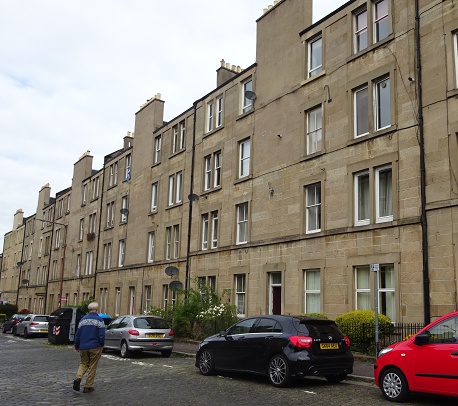
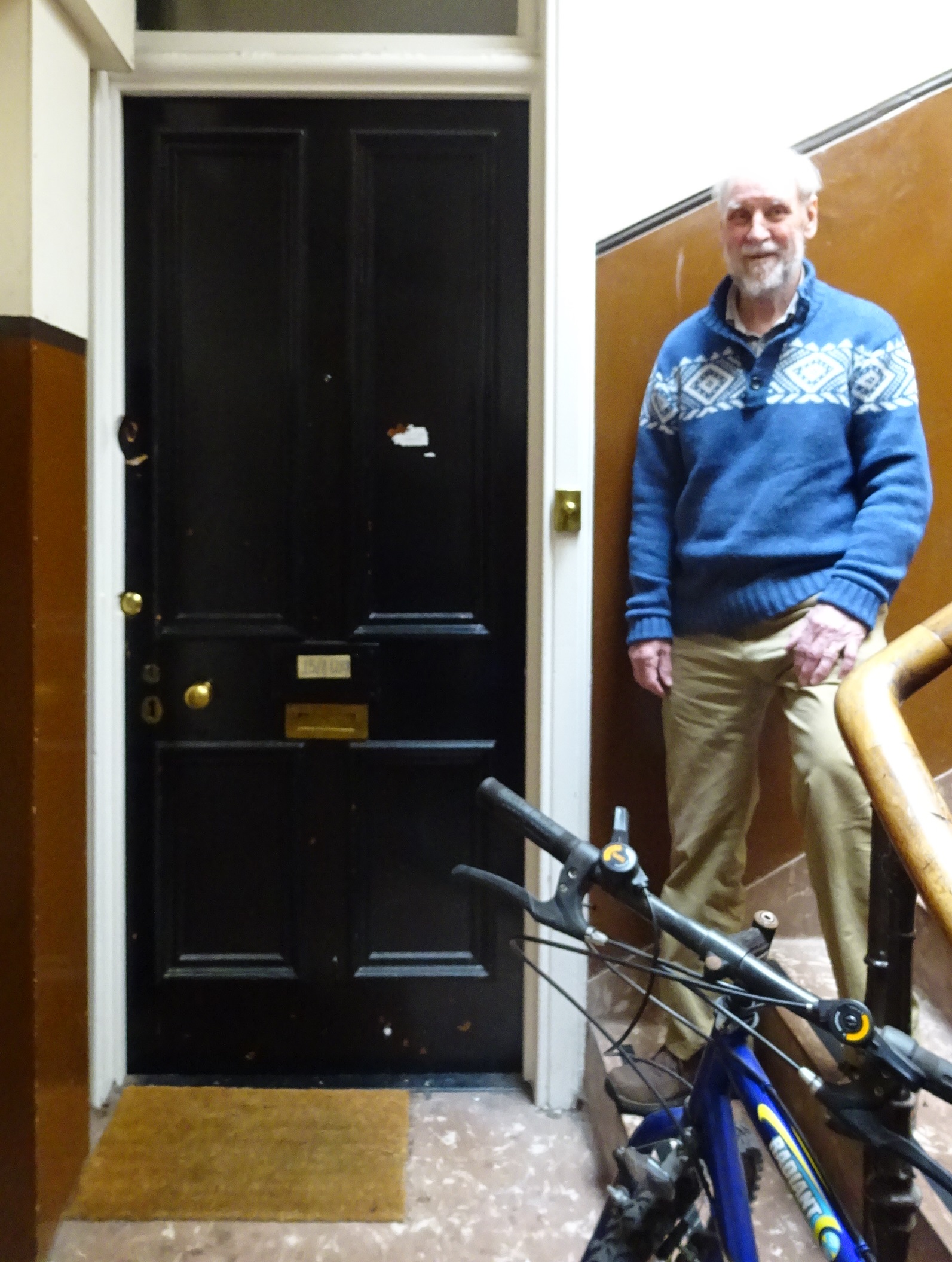
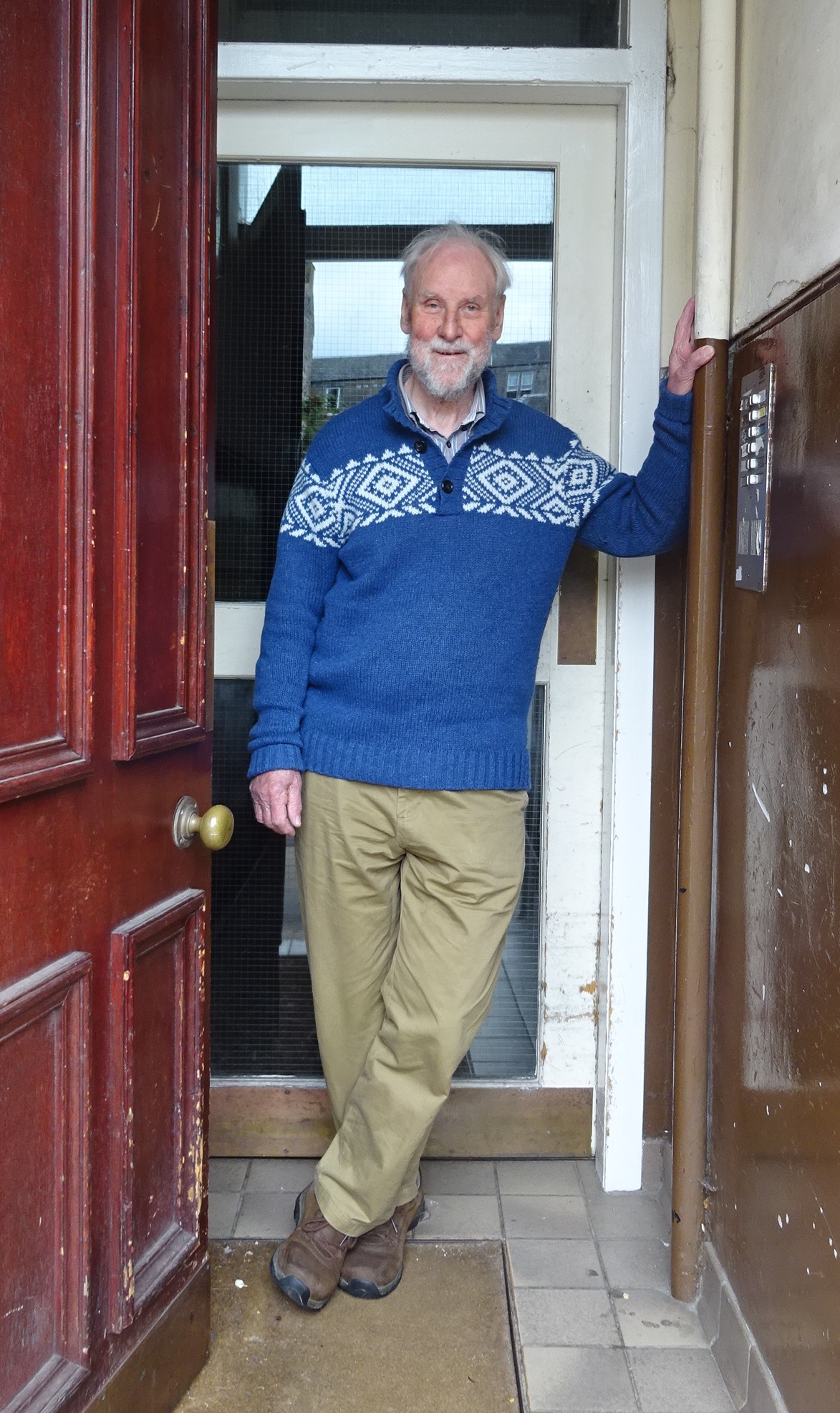
The friendship flourished and on 2 June 1926, when he was 33, Robert McInnes married Madge Watt. I think that his parents’ flats in Cathcart Place and Dalry Road had been rented properties. Robert was not highly paid, but he had been saving up to buy a home for himself, and before the wedding he had bought a flat in 15 Cathcart Place, across the street from his boyhood home. That tenement is on the right of the Cathcart Place photograph above (beyond the red car) and the photograph below shows me walking towards the street level entrance door.
In the next post I hope to write more about the house where I was born.








 Bennet McInnes