The previous post in this series of octogenarian musings, ‘Thousands of mornings’, originally had a comment box and I appreciated what several readers said to encourage me to keep going: I’ll try to do so, at my own slow pace.
I know that some blogs become entertaining daily conversations, but I’ve decided that I have insufficient mental energy for that and I’ve removed the comment box. (If you would like to get in touch, please feel free to email me: bennetmcinnes AT fastmail DOT fm.)
For this post I want to use an octogenarian musing from my father, Robert McInnes. I happen to have an account of his early life, produced by him when he was more than a year older than I am now, and I think it gives a useful insight into my background. In 1979, when he was 87 years old, he responded to an advertisement placed by ‘archives at Sunderland of personal experiences in the Great War’. On 11 May 1980 he was interviewed by Mr P H Liddle of the Department of Geography and History of Sunderland Polytechnic, Forster Building, Chester Road, Sunderland SR1 3SD. A tape recording was made, which I suppose is now part of the archives at Sunderland. The following paragraphs (those in italics) were probably written as the script for that recording.
I was born on the 23rd of June 1892 in Edinburgh in my parents’ home at 20 Cathcart Place. My father was a woodcarver with a firm of cabinetmakers and upholsterers, J & T Scott of 10 George Street, Edinburgh; he worked at their workshop in Devon Place, near Haymarket. I went to Dalry Road School, starting at the age of five in 1897, and leaving at the age of fourteen in 1906.
I started work that summer with a wholesale fruit and vegetable firm, Wood, Ormerod & Co, whose warehouse was in 3 Scotsman Buildings, Market Street, and remained with that same firm till I retired on the 28th of July 1962. Some weeks before I left school my father had spoken to the proprietor of the firm, Mr F L Harris, about the possibility of a job for me. Mr Harris was a member of one of the Glanton Exclusive Brethren Assemblies in Edinburgh; my parents were members of the George Street Assembly.
For the Trades Holiday Week my parents had taken a room in a house in Musselburgh, a seaside town a few miles from Edinburgh city centre. They and my two younger sisters, aged thirteen and six, slept in that room. My younger brother, aged ten, and I slept in a room belonging to a night shift worker whose mother was a member of the Glanton Brethren Assembly in Musselburgh. Mr Harris sent a postcard in the middle of that week to 20 Cathcart Place and a neighbour forwarded it to Musselburgh, where it arrived on the Friday; it asked me to call at the warehouse in Market Street.
On the Saturday I went by train to the Waverley Station, adjacent to Market Street, and went to see Mr Harris. He needed an office boy and started me straight away addressing envelopes. I worked from about 8.30am to 2.00pm, when I was sent home with payment of a sixpence. I continued work the following week at a wage of five shillings a week.
My parents had originally been members of the United Presbyterian Church at Bristo in Edinburgh but not long after their marriage in 1890 they left that church to join the Exclusive Brethren. I was taken to the Sunday meetings of the Brethren Assembly in George Street from early childhood, usually to the worship service at 11.00am and the gospel service at 6.30pm.
At the outbreak of war in 1914 I was one of the clerks at Wood Ormerod, my responsibility being to check the goods entering and leaving the warehouse. The firm had a staff of over forty men; there were no female employees before the 1914-1918 War. A few of the men enlisted early in the War. I was occasionally asked by recruiting sergeants to enlist but there was no great pressure to do so.
Among the Brethren there was a wide range of views about military service. Although I was not yet a member of the Assembly – I did not ‘come into fellowship’ till 1916 – I had become a Christian in 1912 and my own feeling about the matter was that a Christian should not carry arms.
The Military Service Act of 1916 allowed conscripts to apply for non-combatant service on conscientious grounds. I followed this course of action and appeared before a tribunal in Edinburgh early in 1916. My memory of the hearing is that it was very sympathetic and fair; I was allocated to non-combatant duties.
On the 20th of March 1916 I reported to the Recruiting Office in Cockburn Street (round the corner from Market Street) and was given a warrant to travel on the 21st of March to Hamilton Barracks in Lanarkshire, where the first Scottish Company of the Non-Combatant Corps was being formed. Two other men, George Cumming and Walter McInnes, neither of whom I had met before, travelled with me to Hamilton, where I received my number – NCC 17. I was at Hamilton till the 29th of May 1916.
The training at Hamilton included drill and various exercises and I remember that I was excused from digging for a time because my left arm was sore after inoculation. On Sundays I went with other members of the Company to an Exclusive Brethren Assembly in Hamilton. I had gone with another man, Jim Waldie, to ask the sergeant if we could be permitted to do this instead of going to the parish church. We were marched as a Company to the town centre and there dismissed to attend the place of worship of our choice. We formed up again after the services and marched back to the barracks.
One Sunday a Zeppelin flew over from Germany and the train in which I was travelling back to Hamilton after a weekend’s leave in Edinburgh – which lasted from midday on Saturday to first parade on Monday – was halted at Polmont Station, near West Lothian.
On the 29th of May, the Company, which included about 95 men, travelled overnight by train to King’s Cross. The officer in charge was Captain Watson of Tain. There was a Sergeant-Major, two sergeants, Sergeant Lasbury of the Royal Scots and Sergeant Gilchrist, possibly of the Black Watch, with several corporals and lance-corporals. From London we went by train to Southampton, where we boarded a troop carrier bound for Le Havre. The crossing was made by night. It was the 3rd of June before we reached our destination, which was Vallé Hereuse. One man, who came from the Outer Hebrides, attempted to commit suicide during the Channel crossing then again at Vallée Hereuse. None of us was killed in action, but one man died from influenza or some other illness.
The Great War ended in 1918, at the eleventh hour of the eleventh day of the eleventh month. I do not know when my father was demobilised from the Army but it must have been soon after that. He returned to Edinburgh, aged 26, and resumed his work there.
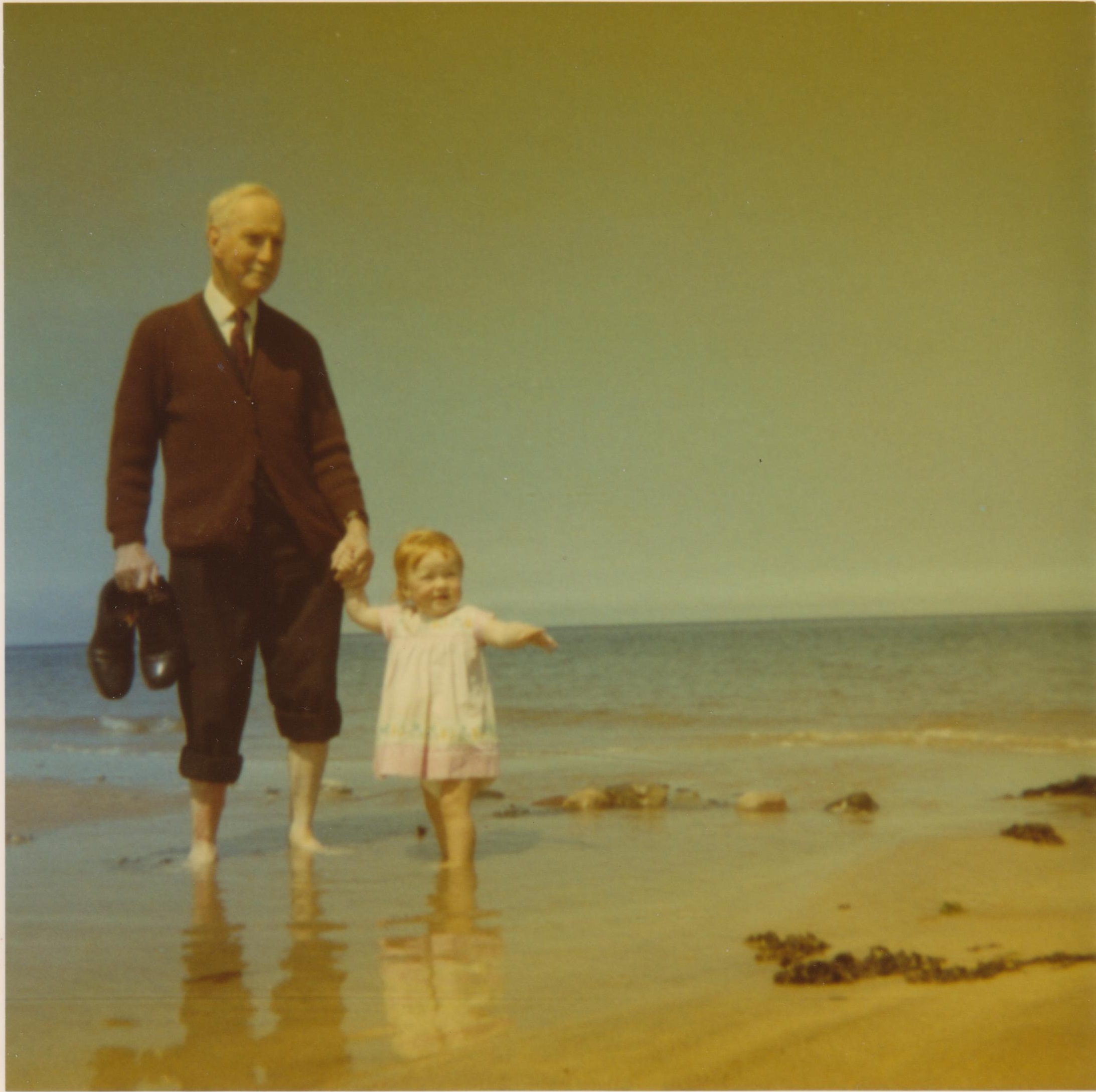
The next part of my father’s story is in draft form and I hope to post it soon. Here, however, is a photograph from 1973 showing him as he was then, aged 81, enjoying the company of his youngest grandchild, my daughter Lorna.
 Bennet McInnes