After the war

In the previous post I quoted from an account given by my father, Robert McInnes, of his departure from civilian life in Edinburgh in 1914 when he was called up for military service in France.  In 1918 (or it may have been in 1919) he returned to Edinburgh to live with his parents and to resume his work in the wholesale fruit and vegetable market.

On a recent visit to Edinburgh I was able to go to Cathcart Place, the street where both my father and I were born (in different houses).  The road is paved with ‘causies’ (causeway stones) and it looks much the same as it did when I was a child, except that now there are painted lines – white lines showing where cars may be parked, and yellow ones where parking is forbidden or at least discouraged. There were very few cars in this part of Edinburgh in the 1930s.  I and the other local children were able to play in the street, unaffected by traffic.
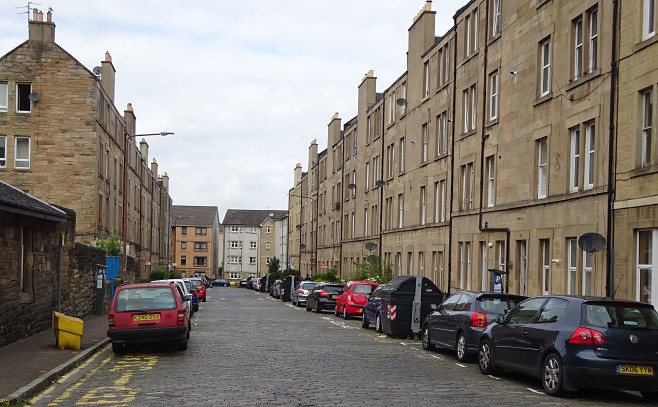
150926 cr Cathcart Place

On either side there are ‘tenements’, the local name for apartment blocks.  These ones were built well over a hundred years ago.  About half way down on the left is number 20 and one of the flats in that tenement is where my father lived with his parents and his three siblings till after the war had ended.

My father’s workplace in Market Street was about a mile and a half from his home and he made that journey routinely four times a day.  There was a frequent tram service down Dalry Road to Haymarket and then along Princes Street past Edinburgh Castle to Waverley Station, where the Fruit Market was, but he usually made the journey on foot, often walking through Princes Street Gardens rather than along the street itself.

Deliveries of fruit and vegetables arrived overnight in closed wagons at a railway siding that ran along Market Street below street level.  The wholesale fruit and vegetable companies owned properties that lined that siding and their staff arrived early in the morning, before 07:00, I think, to unload the wagons into the warehouses.  Retailers came during the day to purchase what they needed for their shops in the city and in neighbouring towns and villages.

Wood Ormerod, the company for which my father worked, supplied a cooked breakfast for their staff at around 09:00 and then allowed them a long meal break in the middle of the day.  My father used to walk home for that meal (called dinner rather than lunch) and then back to work again for three or more hours before returning home for the evening meal (called tea, although it usually included a substantial cooked dish).  I realize that he led a disciplined life, with good meals and healthy exercise, often walking around six miles a day.

His mother died in 1924, aged 66, and at about that time the family moved from their flat in Cathcart Place to a top floor flat at 52 Dalry Road, a short walk away.
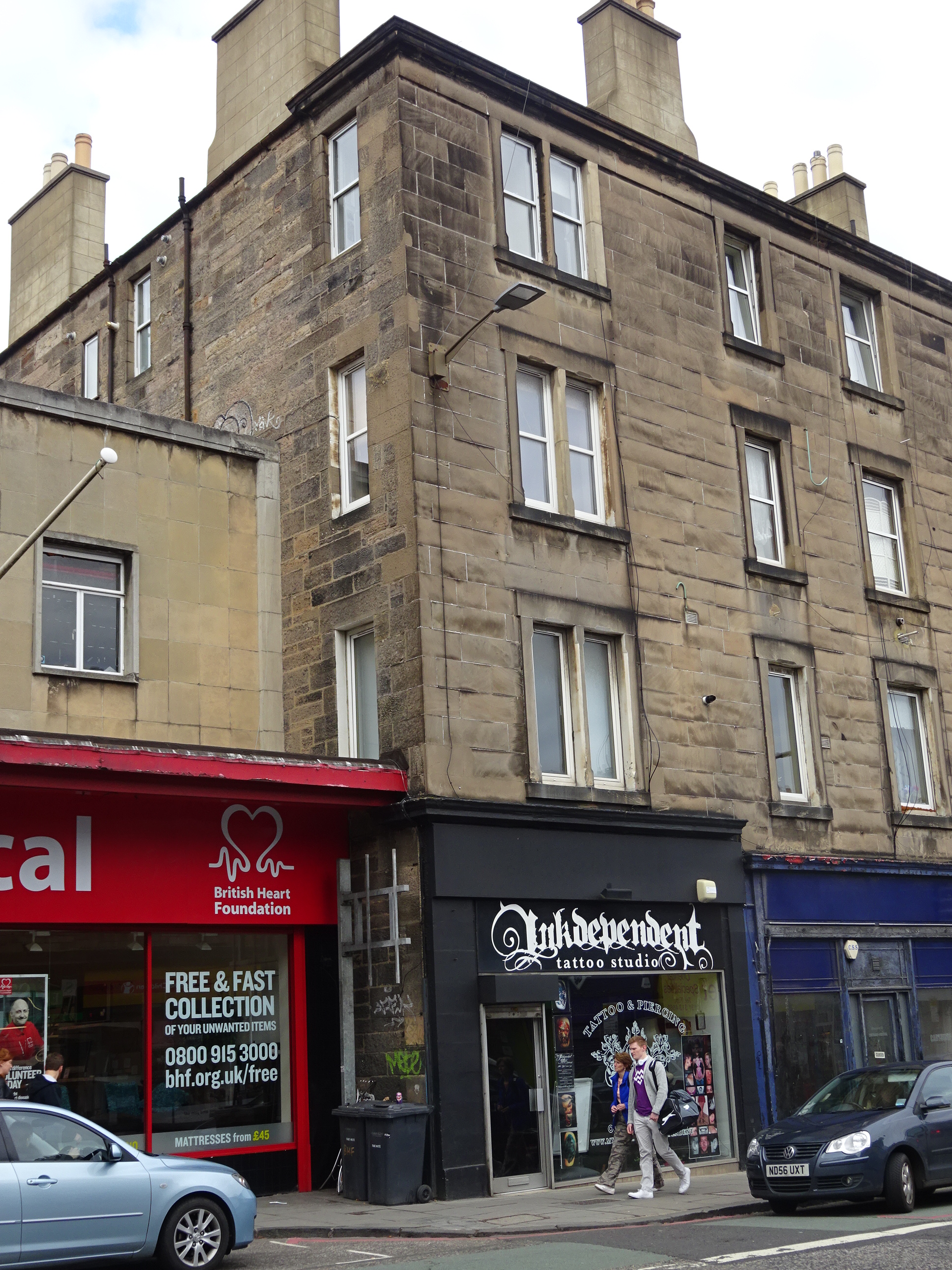
DSC02140

Here is a photograph of that flat.  It has two windows looking out to Dalry Road below, three windows looking west, and another four windows (not visible in this shot) looking north.

Also in Dalry Road, not far from number 52, there was a shop that sold umbrellas, leather handbags, and a variety of items that were described as fancy goods, which is where my mother comes into the story.

Marjory Duff Watt was the youngest of the four children of Andrew Watt and Anne Morrison.  She was born on 14 February 1896 and lived at 2 St David’s Terrace, near Morrison Street in Edinburgh.  Madge (as she was usually called) went to Torphichen Street School and left in 1910 when she reached the age of 14.  Her mother had been looking out for a career opportunity for her, although that sounds rather too grand: basically she wanted to help her to earn a living.  One day in 1910 my grandmother walked down Morrison Street to Haymarket and then up Dalry Road.  There she noticed an advertisement in the umbrella shop window inviting job applications for work as a sales assistant.  I don’t know if Madge had expressed any interest in such work but her mother took her to the shop and she got the job, which she continued to do for the next sixteen years.  The shop was about half a mile from her home.

The owner of the shop, Tom Chambers, happened to be a member of the Glanton Brethren Assembly in George Street which was attended by the McInnes family.  Young Madge was invited to join a Bible Class that was led by a member of the Chambers family.  She did so and eventually decided to leave the Church of Scotland to which her family belonged and join the Brethren.  The Church of Scotland minister tried to persuade her that she was just the type of sincere Christian that he needed in his congregation but she remained convinced that she ought to leave.  She remained a member of the Glanton Brethren for the rest of her life.

Madge’s father died in 1919 and when her three older siblings married and left home she became her mother’s main support and I expect that eventually her earnings provided most of the family income.  My grandmother may well have wondered what would happen to her if her daughter got married.

I do not know when Madge Watt became friendly with Robert McInnes but I do know that they would often meet each other at the Sunday services and other meetings of the Brethren.  He would sometimes go into the umbrella shop as he passed by on his way to or from his dinner.  When I was a child my mother told me that on one occasion he demonstrated the filling effect of his meal.  Like most men at that time he wore a three piece suit.  The sleeveless waistcoat had a small belt at the back which could be adjusted.  One day Robert loosened his waistcoat when he left work for the dinner break and called in at the umbrella shop to say hello.  He pointed out that his waistcoat was very loose and remarked that he was feeling hun gry. After dinner he called in again and demonstrated that his dinner had made a noticeable difference:  the waistcoat was now very tight!  I wasn’t sure that I believed my mother when she said that she was fooled by this demonstration.

The friendship flourished and on 2 June 1926, when he was 33, Robert McInnes married Madge Watt.  I think that his parents’ flats in Cathcart Place and Dalry Road had been rented properties.  Robert was not highly paid, but he had been saving up to buy a home for himself, and before the wedding he had bought a flat in 15 Cathcart Place, across the street from his boyhood home.  That tenement is on the right of the Cathcart Place photograph above (beyond the red car) and the photograph below shows me walking towards the street level entrance door.
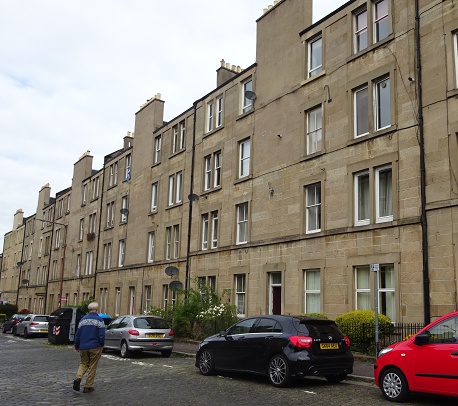
150925 cr BM going to 15 CP

In the next post I hope to write more about the house where I was born.
Conscripted for the Great War

The previous post in this series of octogenarian musings, ‘Thousands of mornings’, originally had a comment box and I appreciated what several readers said to encourage me to keep going:  I’ll try to do so, at my own slow pace.

I know that some blogs become entertaining daily conversations, but I’ve decided that I have insufficient mental energy for that and I’ve removed the comment box.  (If you would like to get in touch, please feel free to email me:  bennetmcinnes AT fastmail DOT fm.)

For this post I want to use an octogenarian musing from my father, Robert McInnes.  I happen to have an account of his early life, produced by him when he was more than a year older than I am now, and I think it gives a useful insight into my background.  In 1979, when he was 87 years old, he responded to an advertisement placed by ‘archives at Sunderland of personal experiences in the Great War’.  On 11 May 1980 he was interviewed by Mr P H Liddle of the Department of Geography and History of Sunderland Polytechnic, Forster Building, Chester Road, Sunderland SR1 3SD.  A tape recording was made, which I suppose is now part of the archives at Sunderland.  The following paragraphs (those in italics) were probably written as the script for that recording.

I was born on the 23rd of June 1892 in Edinburgh in my parents’ home at 20 Cathcart Place.  My father was a woodcarver with a firm of cabinetmakers and upholsterers, J & T Scott of 10 George Street, Edinburgh;  he worked at their workshop in Devon Place, near Haymarket.  I went to Dalry Road School, starting at the age of five in 1897, and leaving at the age of fourteen in 1906.

I started work that summer with a wholesale fruit and vegetable firm, Wood, Ormerod & Co, whose warehouse was in 3 Scotsman Buildings, Market Street, and remained with that same firm till I retired on the 28th of July 1962.  Some weeks before I left school my father had spoken to the proprietor of the firm, Mr F L Harris, about the possibility of a job for me.  Mr Harris was a member of one of the Glanton Exclusive Brethren Assemblies in Edinburgh;  my parents were members of the George Street Assembly.  

For the Trades Holiday Week my parents had taken a room in a house in Musselburgh, a seaside town a few miles from Edinburgh city centre.  They and my two younger sisters, aged thirteen and six, slept in that room.  My younger brother, aged ten, and I slept in a room belonging to a night shift worker whose mother was a member of the Glanton Brethren Assembly in Musselburgh.  Mr Harris sent a postcard in the middle of that week to 20 Cathcart Place and a neighbour forwarded it to Musselburgh, where it arrived on the Friday;  it asked me to call at the warehouse in Market Street.  

On the Saturday I went by train to the Waverley Station, adjacent to Market Street, and went to see Mr Harris.  He needed an office boy and started me straight away addressing envelopes.  I worked from about 8.30am to 2.00pm, when I was sent home with payment of a sixpence.  I continued work the following week at a wage of five shillings a week.

My parents had originally been members of the United Presbyterian Church at Bristo in Edinburgh but not long after their marriage in 1890 they left that church to join the Exclusive Brethren.  I was taken to the Sunday meetings of the Brethren Assembly in George Street from early childhood, usually to the worship service at 11.00am and the gospel service at 6.30pm.  

At the outbreak of war in 1914 I was one of the clerks at Wood Ormerod, my responsibility being to check the goods entering and leaving the warehouse.  The firm had a staff of over forty men; there were no female employees before the 1914-1918 War.  A few of the men enlisted early in the War.  I was occasionally asked by recruiting sergeants to enlist but there was no great pressure to do so.

Among the Brethren there was a wide range of views about military service.  Although I was not yet a member of the Assembly – I did not ‘come into fellowship’ till 1916 – I had become a Christian in 1912 and my own feeling about the matter was that a Christian should not carry arms.

The Military Service Act of 1916 allowed conscripts to apply for non-combatant service on conscientious grounds.  I followed this course of action and appeared before a tribunal in Edinburgh early in 1916.  My memory of the hearing is that it was very sympathetic and fair;  I was allocated to non-combatant duties.

On the 20th of March 1916 I reported to the Recruiting Office in Cockburn Street (round the corner from Market Street) and was given a warrant to travel on the 21st of March to Hamilton Barracks in Lanarkshire, where the first Scottish Company of the Non-Combatant Corps was being formed.  Two other men, George Cumming and Walter McInnes, neither of whom I had met before, travelled with me to Hamilton, where I received my number – NCC 17.  I was at Hamilton till the 29th of May 1916.  

The training at Hamilton included drill and various exercises and I remember that I was excused from digging for a time because my left arm was sore after inoculation.  On Sundays I went with other members of the Company to an Exclusive Brethren Assembly in Hamilton.  I had gone with another man, Jim Waldie, to ask the sergeant if we could be permitted to do this instead of going to the parish church.  We were marched as a Company to the town centre and there dismissed to attend the place of worship of our choice.  We formed up again after the services and marched back to the barracks.

One Sunday a Zeppelin flew over from Germany and the train in which I was travelling back to Hamilton after a weekend’s leave in Edinburgh – which lasted from midday on Saturday to first parade on Monday – was halted at Polmont Station, near West Lothian.

On the 29th of May, the Company, which included about 95 men, travelled overnight by train to King’s Cross.   The officer in charge was Captain Watson of Tain.   There was a Sergeant-Major, two sergeants, Sergeant Lasbury of the Royal Scots and Sergeant Gilchrist, possibly of the Black Watch, with several corporals and lance-corporals.   From London we went by train to Southampton, where we boarded a troop carrier bound for Le Havre.   The crossing was made by night.   It was the 3rd of June before we reached our destination, which was Vallé Hereuse.   One man, who came from the Outer Hebrides, attempted to commit suicide during the Channel crossing then again at Vallée Hereuse.   None of us was killed in action, but one man died from influenza or some other illness.

The Great War ended in 1918, at the eleventh hour of the eleventh day of the eleventh month.  I do not know when my father was demobilised from the Army but it must have been soon after that.  He returned to Edinburgh, aged 26, and resumed his work there.

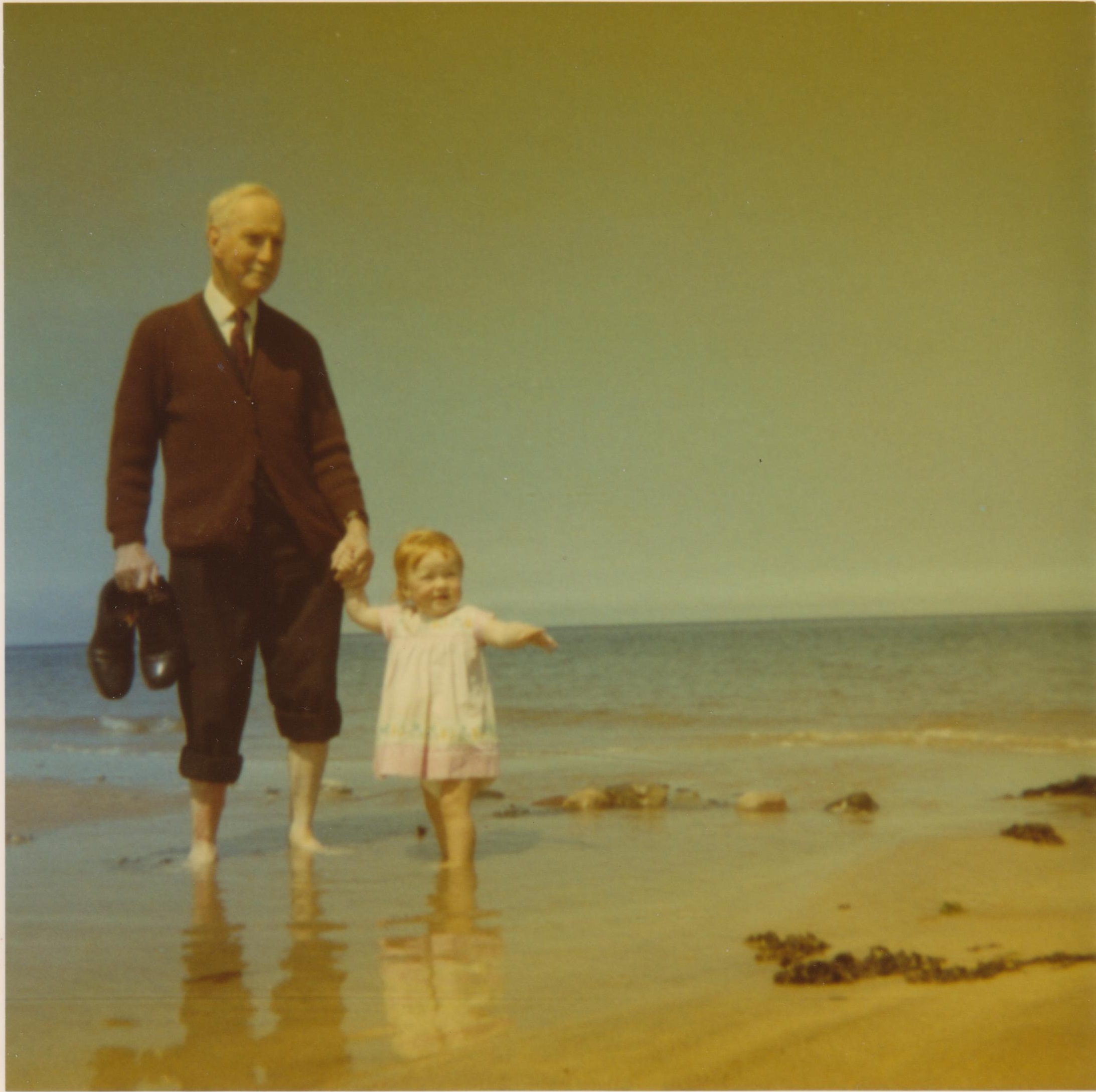
The next part of my father’s story is in draft form and I hope to post it soon.  Here, however, is a photograph from 1973 showing him as he was then, aged 81, enjoying the company of his youngest grandchild, my daughter Lorna.