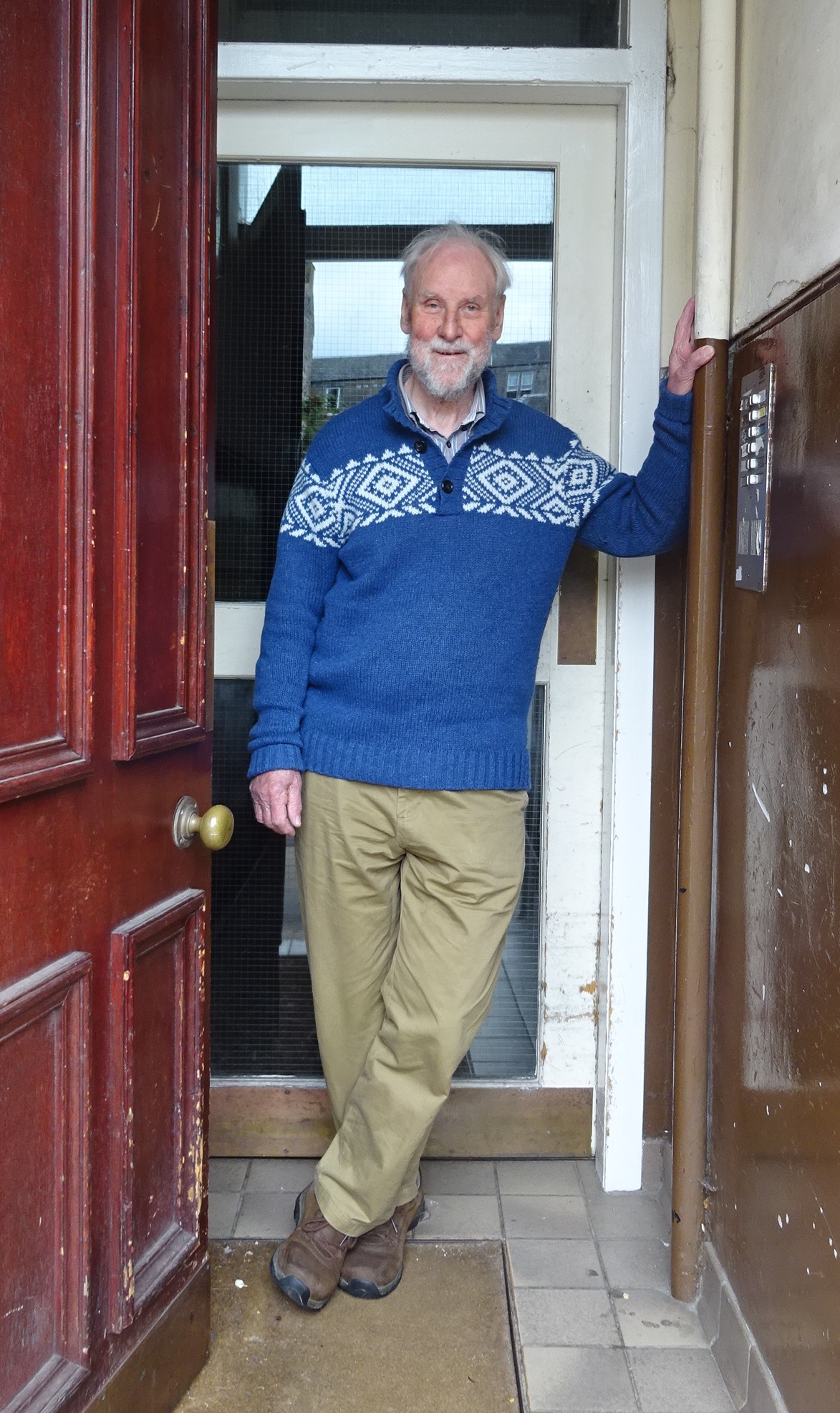
The following photograph, taken in September 2015, shows 15 Cathcart Place, a residential tenement in Edinburgh. It has eleven small flats (apartments) and I was born in flat 8 (on the floor below the top floor). That was my home from 1929 to 1934. The three windows on the left side of this shot belong to flat 8, including the one with a white blind. (I’m standing in the street level entrance door that leads to the internal stair.)

The flat has two rooms looking out over the street. The two narrow windows on the left of the photograph are in what we called the parlour, a room used mainly when we had visitors. The wider window with a white blind is in what was Granny’s bedroom. The other windows of the flat are on the far side of the building.
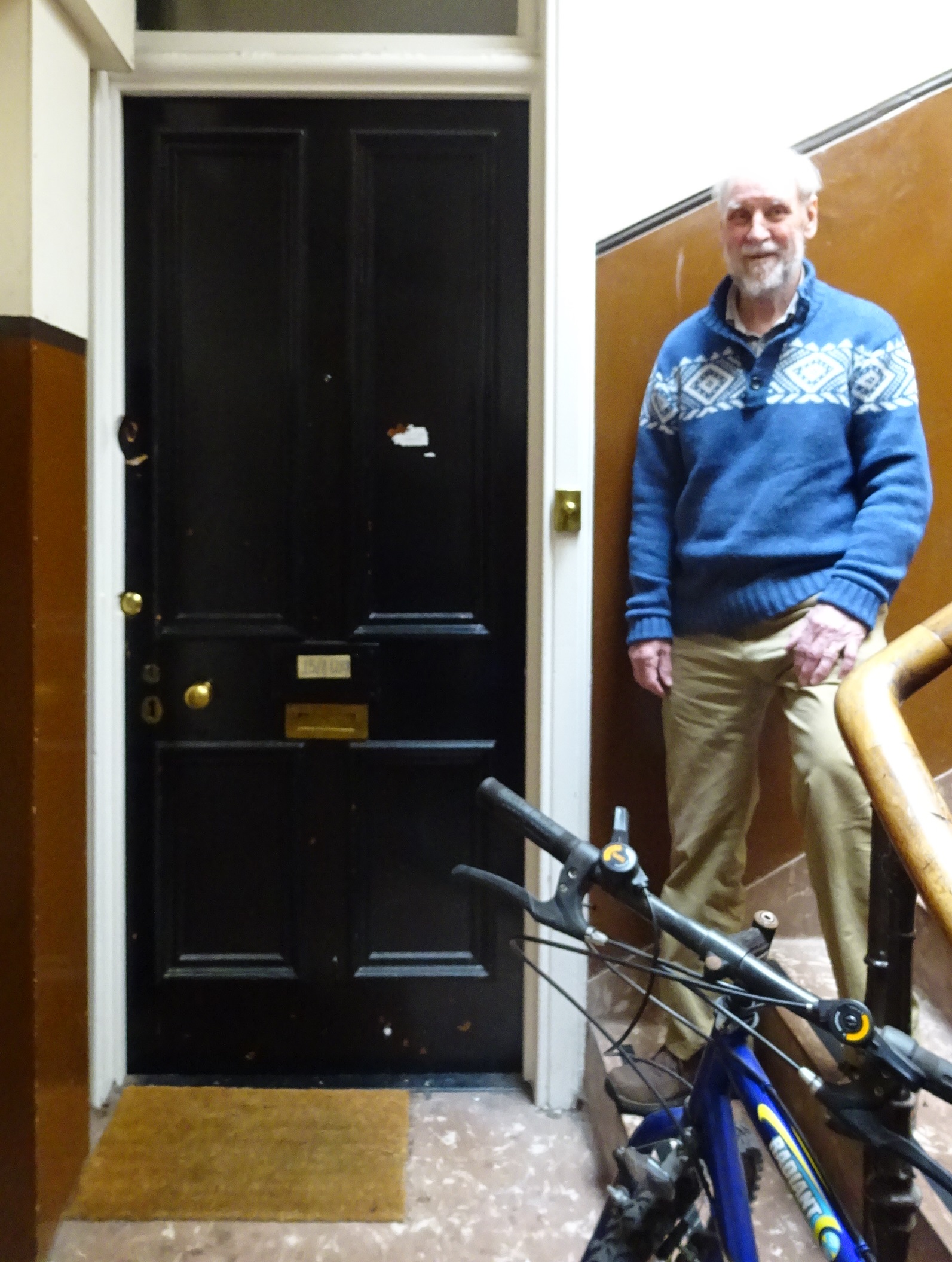
The next photograph shows the internal stair. The property now has mains electricity but when I lived in it there was none. At night, especially in winter, the stair was dark and a battery-operated torch was often in use. A grassy communal area at the back of the building was formerly used for hanging out the washing but there was none there when I visited.

There are twenty or more steps between floors. The next photograph shows me two flights up, outside the door of flat 8.
The busiest room in the house was the kitchen. It has a wide window that faces northeast, looking out over the city of Edinburgh towards the Firth of Forth. When I lived in this flat the kitchen had a cast iron range with at least one built-in oven heated by a central coal fire. An iron kettle could be hung over the fire to boil water. Heavy iron pans could be balanced above the fire.
The kitchen had a large central table where meals were prepared and eaten. In the window recess there was a large kitchen sink with one cold water tap. When hot water was needed it was transferred in a kettle from the range. In a corner of the room away from the window there was a bed recess, an area large enough to take a double bed, and it may have had a curtain that could be drawn across to make the area into a little bedroom. That was where my parents slept.
Coal fires were the only form of heating in the house when I lived there. The fire in the range was kept burning most of the time, and there were fireplaces in Granny’s bedroom and in the parlour. The house had no mains electricity. It did have mains gas but that was used only for gas lamps, suspended from the ceiling in each of the three main rooms. A fanlight over the flat door did allow some daylight into the hall.
There was no bathroom in the flat – only a small toilet opening off the hall. This small room had no window, but it did have an electric battery torch fixed to the wall. When I was small I was probably bathed in the kitchen sink or in a large zinc tub placed near the range in the kitchen. When I was older I remember my father taking me on a short walk to the nearby public baths where he paid for a bathroom that had a very large bath with lots of hot water available. I think we had the choice of taking our own towels or of hiring towels there.
I left 15 Cathcart Place after this brief visit to my childhood home still struggling to remember how life had been for me all those years ago.

 Bennet McInnes