
From 1996 to 2004 my home was in Pitlochry, a small town in the centre of Scotland. It had a local branch of a club for professionals called Probus and although I wasn’t a member I did give occasional talks. Some notes that I made for a talk on 5 August 2004 have recently emerged from my archives (also known as ‘the piles of papers’) and my daughter Lorna has suggested that I should turn these notes into a short series of blog posts. So here goes.
The club secretary asked for an indication of the subject matter of the talk and I suggested that I might offer an answer to a simple question: ‘Is there any life in the universe apart from the life on Earth that we know about already?’

Because I spent most of my working life (1960 to 1989) as an astronomer, mostly based at the Royal Observatory, Edinburgh (shown above as it was when I worked there), I’ve had to think about that question more than most people, but I don’t regard myself as an expert and warn any reader that what I say on the subject should be treated with caution. My scientific training means that I try to work from evidence wherever possible, but some of what I regard as evidence might well seem to you to be wild speculation or wishful thinking.
The talk was in two parts. The first dealt with the universe – how old it is and how large it is. The second part dealt with life, actual and possible – on the Earth, on the Moon, on Mars, on other bodies in the solar system, and in places so far away that direct exploration is apparently impossible.
An old universe
Views on the history of the universe range very widely. At one extreme there are people who believe that it’s very young: that it was created only about six thousand years ago. At the other extreme there are people who believe that it’s infinitely old: that it did not have a beginning at all. I think that most educated people in the western world reject both of these extreme views and accept that the universe is very old and that space and time came into being, together, about 15 thousand million years ago with a unique event known as the big bang. (I could have written 15 billion years, but when I was at school a billion meant a million millions, and to avoid confusing myself I usually avoid using the word billion.)
This belief about the age of the universe is based on the findings of the last few centuries of scientific investigation, and there is a well-established branch of science, called cosmology, which deals with the origin of the universe, its development over an unimaginably long time, and its probable end in the very distant future.
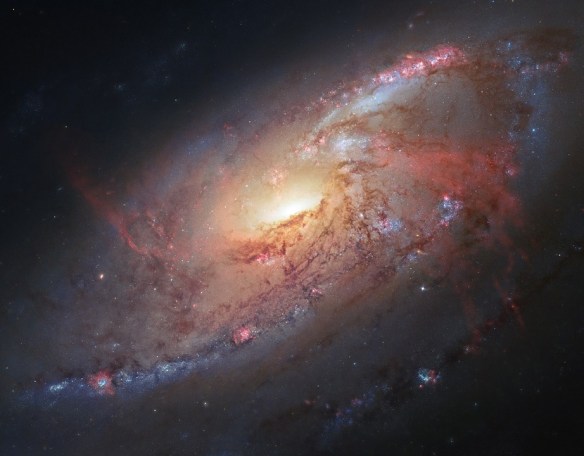
A spiral galaxy
The evidence suggests that the great star systems called galaxies (like the one shown above) began to form out of the basic material of the universe more than 10 thousand million years ago. Our solar system (the Sun and its family of planets, including the Earth) condensed out of the gas and dust in this part of the universe, the Milky Way Galaxy, only about 5 thousand million years ago.
Our solar system
Our Earth is a massive spherical ball of rock, the central parts very hot and fluid and the outer crust cool and solid but with much of the surface covered by water. Because we’re on it – and pretty well confined to it – the Earth is the centre of our universe. We’re ‘here’, and everything else is ‘out there’. To us the Earth feels completely steady, immovably fixed at the centre of the universe. That’s the common sense view of things, but in order to understand such basic parts of our experience as day and night, summer and winter, the movements in the sky of stars, planets, comets, and so on, we human beings have had to modify that view, and to think of our planetary home as moving round the very much larger Sun.
Although we can’t feel the Earth moving, we now know it’s a sphere with a diameter of 13 thousand kilometres, that it spins on its axis once a day, and that it moves, in a roughly circular orbit once a year, round the Sun at a distance of around 150 million kilometres. The Sun is also a sphere. But it’s very much larger than the Earth: it has a diameter of 1.4 million kilometres, more than a hundred times that of the Earth. It’s the dominant source of light in this part of the universe. The next brightest light in the sky is the Moon. It’s also spherical, but because of the way that we see it, by reflected sunlight, it appears to change shape from a very thin crescent at New Moon to a circular disk at Full Moon, and then shrinks again to a thin crescent (facing the other way) before going through the same cycle over the next 30 or so days: the Moon has a diameter of 3.5 thousand kilometres, only about a quarter of the Earth’s diameter, and it orbits, once a month, round the Earth at a distance of 380 thousand kilometres.
During the night hours, when the Sun is below the horizon, the sky is peppered with bright spots of light (unless of course there are clouds spoiling the view). The vast majority of these lights are stars, bodies like the Sun, shining because they’re burning up the material that composes them. A small number of them, however, are very much closer to us. Unlike the stars, which remain in a fixed pattern in the night sky, these spots of light move about against the star background, behaviour that earned them the title of wandering stars. They are the planets, orbiting the Sun in the same way as the Earth does: Mercury, Venus, Mars, Jupiter, and Saturn. (There are other planets, visible only with optical aid.) The planets do not twinkle as much as the stars because they are so much nearer to us than the stars: even if we cannot see the disks of the planets the beams of light that come from them to the irises of our eyes have greater width as they pass through the shimmering atmosphere than the extremely slender beams that come from the stars.
Mercury and Venus are closer to the Sun than we are. In the night sky Mercury is always so near to the Sun that it’s visible only soon after sunset and soon before sunrise. It’s quite faint and not very easy to identify. I’ve identified it only a few times, when I knew precisely where to look.
Venus is very much brighter, so much so that it’s sometimes visible in the day sky before the Sun has gone down or after it has risen. That is why it’s sometimes called the Evening Star or the Morning Star. With optical aid Venus can be seen to have a crescent shape, like the Moon. Venus is slightly smaller than the Earth but its atmosphere would be toxic to humans and it does not offer a home for life as we know it.
Mars, Jupiter and Saturn orbit the Sun farther out than the Earth. Mars has a diameter of 6.8 thousand kilometres, considerably smaller than the Earth, but larger than the Moon. It has a reddish colour, which helps to identify it.
Jupiter, with a diameter of more than 140 thousand kilometres, is the largest of the planets. It shines brightly, but because of its greater distance from the Sun it is not usually as bright as Venus is.
Saturn, around 120 thousand kilometres in diameter, is somewhat smaller than Jupiter. It is surrounded by rings of small rocky satellites, visible only with optical aid.
Large numbers
Making sense of large numbers like a thousand million is not easy and so the next instalment of this blog will offer some help by describing simple models of the solar system.
Earlier posts in this blog did not offer the invitation to make comments but I’ve changed that for this post.
 Bennet McInnes
Fascinating post although I can’t claim to understand these huge concepts. I have always loved looking at the stars, and one of the few apps I have on my phone is a sky map, which I enjoy using to try to identify what I’m looking at. My daughter (now 18) has, unlike me, always been frightened by looking up at the night sky! I remember pointing out Pleiades to her when she was about 8, and beginning to tell her the Greek myth of the 7 sisters. She burst into tears and remained inconsolable at the thought that one of the sisters was *lost* – so my attempt to make the stars friendlier to her backfired badly… Thank you for your most interesting blog!
Yes, Jo. I was really grateful to be working at the ROE. Finding the Andromeda galaxy shining in the night sky and realizing that the light hitting my eye had left it two million years before I was born always gave me food for thought.
Very interesting! What a fascinating job you had at the observatory. I keep meaning to go there for one of their public viewing evenings. I’m always amazed when I read about the night sky. I have seen Mercury a couple of times, only after a great deal of patient searching. I also like finding the Andromeda galaxy and remembering how far away it is (and how long it has taken the light to reach us). When I’m worried about things, it tends to put them into perspective!